

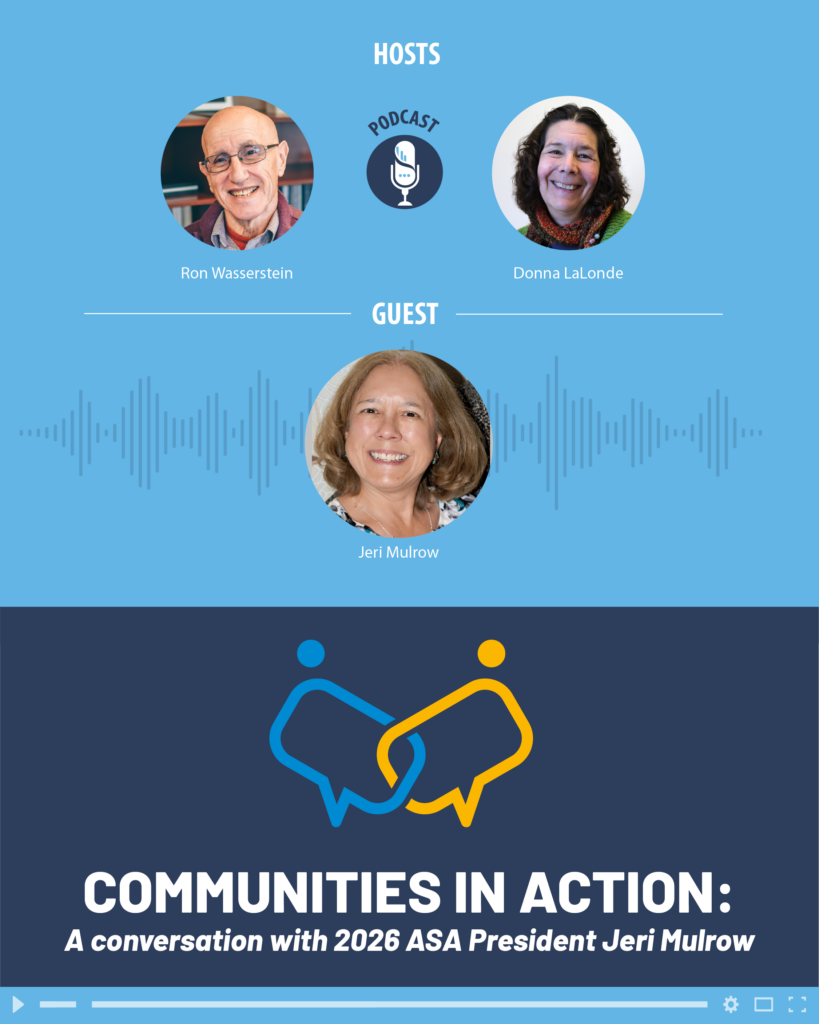
Interested in helping local communities by being an active presence and spokesperson for statistics and data science? On a recent episode of the Practical Significance podcast, cohosts Donna LaLonde and Ron Wasserstein welcomed ASA President Jeri Mulrow, who shared her thoughts about leadership, service, and the evolving role of statistics. She also called on fellow members to participate in her presidential initiative, Communities in Action.
Donna LaLonde: Tell us about your day job.
Jeri Mulrow: I am currently a vice president and sector lead at Westat. I oversee our statistics and data science, survey management and design, and our data operations groups.
We do a lot of very large data collection activities for the federal government, including things like the National Assessment of Educational Progress and the Medical Expenditure Panel Survey. We are also pushing the boundaries in data science and AI. It’s a great place to work with many great people and there are many interesting, challenging problems we can work on and help solve.
Donna LaLonde: Looking at where you started to where you are now, what surprises you most about that career trajectory?
Jeri Mulrow: Wow—everything. I grew up as a little girl in Helena, Montana, and I probably never would have dreamed I would land in the Washington, DC, area, have a career in the federal government, end up being the deputy director at the Bureau of Justice Statistics, and be a vice president at an organization like Westat.
All of it has amazed me. The most amazing part to me is not just the work I’ve done, but the people I’ve met. I have met so many amazing, wonderful folks throughout my career, many through the American Statistical Association. It’s my home away from home—my happy place.
Ever since I joined the organization as a graduate student, I’ve felt at home and very comfortable talking with people in the ASA.
My career was certainly not straight and narrow or following a single path. It was more meandering—taking opportunities, taking a few risks, working with people I liked, and working on problems that interested me. I wasn’t always focused on the next promotion; I was more interested in the next interesting problem to solve and how I could get involved.
Ron Wasserstein: I want to zero in on your presidential initiative. It clearly resonates because the webinar in December had a tremendous turnout and generated a lot of interest. Please tell us about your goals for this initiative and why it’s important to you.
Jeri Mulrow: I’m really excited about Communities in Action. I want to help empower members of our statistical community to engage at the local level in the communities where they live. I want to bring our statistics and data science communities together with the places we live and work.
You’re right about the town hall. I had the opportunity to share some examples of what inspired me. I want to mention a few others.
I spent a majority of my career working in the federal statistical system, alongside many colleagues, producing data used for national decision-making. That was very rewarding and challenging work because we could see how the data drove better decisions and improved understanding of what was happening in the areas being measured.
The challenge was often how to collect the data, where to get it, and how to get cleaner data. Many federal data sources come from local levels: states; counties; cities; parishes; and neighborhoods. That made me think: How could local communities also use data for decision-making? Some do, but I believe more could. And those who do could sometimes use it better.
Who can help better than statisticians and data scientists? We are good at working with data and solving problems. We bring the statistical problem-solving process to our work across many aspects of life.
I also thought about the ASA’s mission and vision: promoting the practice and profession of statistics and a world that relies on data and statistical thinking to drive discovery and inform decisions. Communities in Action brings those to life for me.
It’s a grassroots call to action at the local level—to be an active presence in our communities and spokespeople for statistics and data science. The goal is to equip members with practical tips and tools to bring their expertise to real community challenges. We will share resources, best practices, and concrete strategies to help people engage—whether they have one hour a year, a month, or a week. I hope everyone sees a way to be involved, even in small ways. I’m really excited about it. Thanks for asking.
Ron Wasserstein: We are all very excited about Communities in Action. Moving to another topic, how do you think AI technologies will change what statisticians and data scientists do?
Jeri Mulrow: I always love that question. I say, “Let me grab my Magic 8 Ball and shake it!” AI technologies are here to stay. People are excited about them, and they can be very useful when used appropriately. Our community brings the foundations AI is built upon. AI can make tasks more efficient and timelier—coding, cleaning data, analyzing data, writing scripts, and creating visualizations.
But AI must be guided and validated. That’s what statisticians and data scientists do well—think about the underlying problems, appropriateness of data, and quality of data sources.
More data isn’t necessarily more information; it depends on what the data can say. We will continue to play a critical role in that. I hope AI gives us more time to think through statistical problem-solving, identify needed data sources, and assess data quality, while AI helps with the weeds. We will still be very busy and must be involved in these processes.
Donna LaLonde: Expand a little on what makes you hopeful for the future of the profession.
Jeri Mulrow: Our profession is always evolving. We constantly think about how to improve what we do and push boundaries. That makes me hopeful.
Over time, we’ve shown we’re adaptable, creative, and persistent. If you’ve attended JSM [Joint Statistical Meetings] and looked at featured lectures and award recipients, you can see how people continue to push forward.
It can feel daunting when things change, but we’re well suited to adapt day to day.
Ron Wasserstein: Some young folks reading may hope to be ASA president or leaders in other organizations. What advice do you have for young folks who may hope to be ASA president or leaders in our organization?
Jeri Mulrow: I don’t know if ASA president was on my list, but I’m honored to be here. My goal has always been to be involved and present in organizations, using my skills to improve things and helping others move forward. Being involved in the ASA has helped me throughout my career—from chapter participation as a graduate student, to Washington Statistical Society committees, to vice president, and now to president.
My advice? Get involved. Be present. Be helpful. When there’s a call for volunteers and you have time, answer it—and really do the work. What has amazed me is that the more I give, the more I get back—often in unexpected ways.
Interested in sharing your ideas for Communities in Action?
Leave a Reply