

As an individual, I am grappling with the questions surrounding the impact of AI technologies, which are not only technical but deeply human. I would like to begin a conversation to acknowledge both the remarkable potential and the genuine challenges AI technologies, particularly the emergence of large language models and generative AI systems, present to our community.
As I write this column, the Project Iceberg Index, which “measures where AI systems overlap with the skills used in each occupation”—is 11.7%. Project Iceberg looks across occupations and skills. According to “‘Rebuilding’ Statistics in the Age of AI: A Town Hall Discussion on Culture, Infrastructure, and Training,” written by David Donoho and coauthors, the landscape of statistical practice is being fundamentally altered.
I believe we are uniquely positioned at the intersection of extraordinary opportunity and profound responsibility. I write not with definitive answers but with an invitation to collective action. The decisions we make now will shape the trajectory of our profession for decades to come.
The pace of change has been staggering. Large language models can draft research papers, write code, analyze data, and engage in sophisticated reasoning tasks. Computer vision systems diagnose diseases, autonomous vehicles navigate complex environments, and recommendation algorithms shape what billions of people see, read, and purchase. We have been surprised by the scale and speed of these developments.
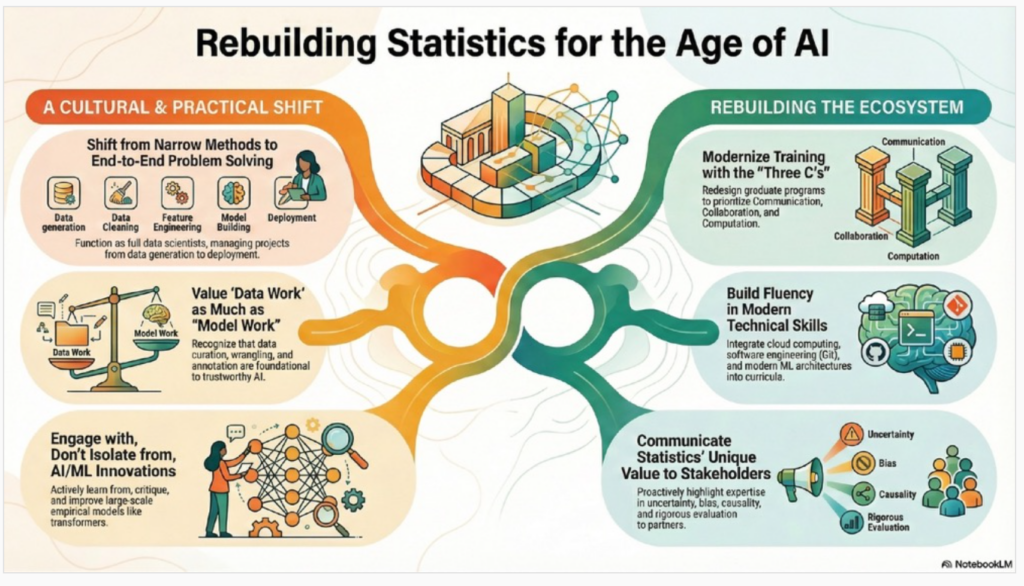
Created by Google NotebookLM. Reprinted with permission.
We understand many of these AI systems are, at their core, statistical models, albeit of unprecedented scale and complexity. The data they consume, the patterns they learn, the predictions they generate, and the uncertainties they fail to quantify all fall squarely within the domain of statistical inquiry. Yet the statistical foundations of these systems are not understood by the broader public.
This disconnect presents both a challenge and an opportunity. The challenge lies in the potential proliferation of AI systems that lack proper uncertainty quantification, are deployed without rigorous validation, and make consequential decisions affecting human lives. The opportunity lies in the unique expertise our community brings to addressing precisely these shortcomings. We understand the data’s provenance is the foundation of trustworthiness. You cannot make good decisions without knowing where the data originated, who collected it, how it was processed, and who it represents. Statisticians have spent more than a century developing frameworks for inference under uncertainty, understanding the limitations of models, and communicating what data can and cannot tell us. These capabilities have never been more valuable.
Perhaps no aspect of the “age of AI” generates more anxiety than its implications for employment and the nature of statistical work, itself. The reality is that AI tools are already transforming how statistical work is performed, and this transformation will only accelerate. Tasks that once required hours of careful coding can now be accomplished in minutes with AI assistance. Even interpreting results and drafting reports, activities we might have considered uniquely human, are now within the capabilities of sophisticated language models. For early-career statisticians especially, the questions of which skills to develop and which career paths to pursue are becoming considerably more complex. Our mission is to promote the practice and profession of statistics. Working together, we can see the entire landscape and build on our tradition of developing guidelines and frameworks to chart a path forward.
In her seminal work In the Age of the Smart Machine: The Future of Work and Power, Shoshana Zuboff described the impact on the nature of work and the skills required by the emergence of information technology. We also know from history that, for example, the mechanization of agriculture did not eliminate the need for human labor; it transformed it. AI will not eliminate the need for statistical expertise, but it will change what that expertise looks like.
In the age of AI, we bring the ability to formulate the right questions, understand the substantive context in which data arise, exercise judgment about when a model is appropriate and when it is not, and communicate findings in ways that inform decision-making. Perhaps most importantly, statisticians will be needed to evaluate AI systems themselves, to audit their performance, to identify their biases, and to ensure their responsible deployment.
The implications for statistical education are profound. Our curricula, developed over decades to equip students with foundational knowledge and practical skills, require thoughtful reconsideration. This does not mean abandoning the fundamentals. More than ever, students will need experience with the ethical dimensions of data science, including questions of privacy, representativeness, and accountability that pervade AI applications.
Students will need the judgment to know when a sophisticated AI approach is warranted and when a simpler method would serve better, the ability to recognize the limits of any model, and the communication skills to convey these nuances to diverse audiences. We need to redouble our commitment to mentorship and ongoing professional development. Through our conferences and publications, we can share best practices and foster dialogue. Through our advocacy efforts, we can promote the funding and institutional support necessary for statistics programs to evolve.
The AI technologies being deployed today make decisions that affect people’s lives, including access to credit, health care, employment, and housing. They shape the information environment in which democratic societies function. The ASA’s Statement on Ethical AI Principles for Statistical Practitioners provides a foundation for navigating this environment.
We must continue to take an active role in the broader societal conversation about AI governance. This means engaging with policymakers, participating in standards development, and contributing our expertise to regulatory frameworks. It also means fostering a culture that prioritizes ethical reflection, encourages raising concerns, and supports colleagues who face difficult decisions about the applications of their work.
As I consider our path forward, several priorities emerge. First, we must grapple with the impact on employment, confront questions of fairness and representation, and contribute to regulatory frameworks. Second, we must strengthen our connections with allied disciplines such as computer science, mathematics, and engineering. The challenges posed by AI are too large and too complex for any single field to address alone. Third, we must advocate vigorously for the value of statistical thinking in an AI-dominated world by demonstrating, through our research and practice, that statistical principles are essential even as the technologies change. It means communicating effectively with the public about what AI technologies can and cannot do and ensuring our expertise is represented in the institutions and organizations shaping the future of AI technologies. Fourth, by continuing our commitment to timely professional development and access to career opportunities, we must attend to the well-being of our members during this period of rapid change. The anxiety and uncertainty many feel are real and should be acknowledged.
I close with a call for engagement. The future of statistics in the age of AI will be shaped by the choices we make as a professional community. Each of us has a role to play. The ASA provides a platform for collective action, but its effectiveness depends on the active participation of the entire community. I look forward to hearing from you and working together toward a future in which data and statistical thinking remain an essential part of decision-making and discovery.
Leave a Reply