
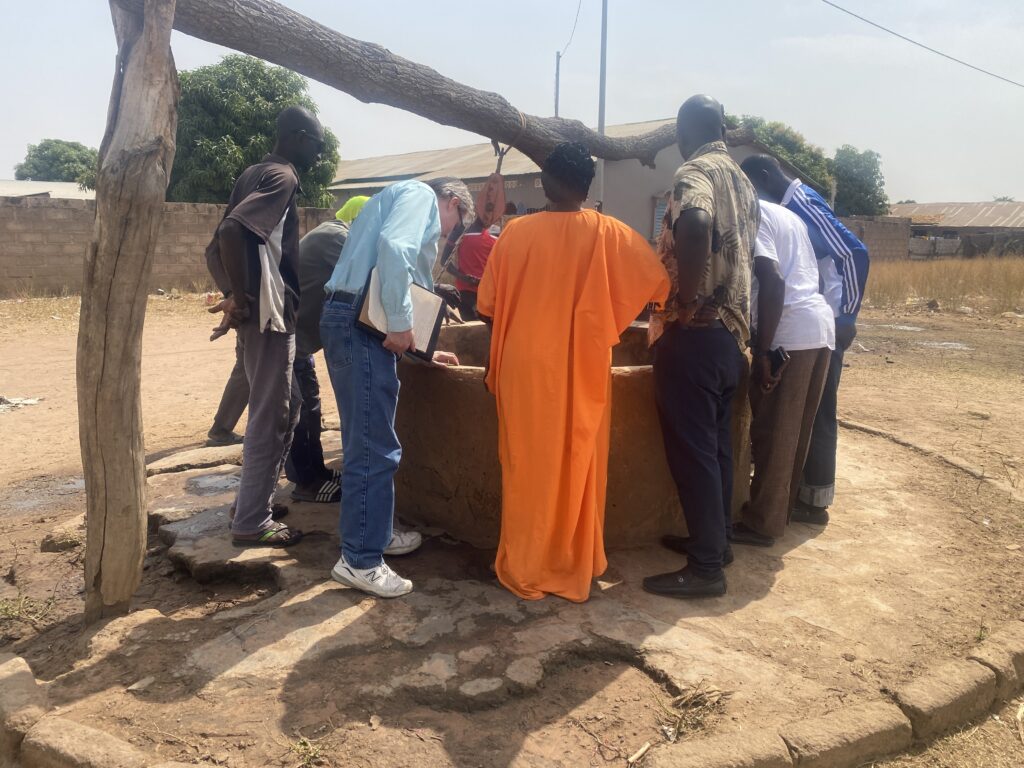
When the National Disaster Management Agency of The Gambia recently decided to strengthen community resilience through improved water access, it turned to ASA founder Jim Cochran for support. Cochran is a professor of statistics and operations research and the Mike and Kathy Mouron Research Chair at The University of Alabama’s Culverhouse College.
Cochran recently helped with the agency’s Community Resilience Through Disaster Risk Reduction Sensitization and Borehole Construction initiative in its Central River Region and Upper River Region projects.
We asked about the project, how he got involved, and what he learned from his mission.
What is the Community Resilience Through Disaster Risk Reduction Sensitization and Borehole Construction project?
Through this project, the National Disaster Management Agency identifies rural villages in desperate need of reliable, sustainable, and affordable sources of potable water. They find funding for drilling boreholes and installing (hopefully solar-powered) pumps in these villages.
How were you chosen for the project?
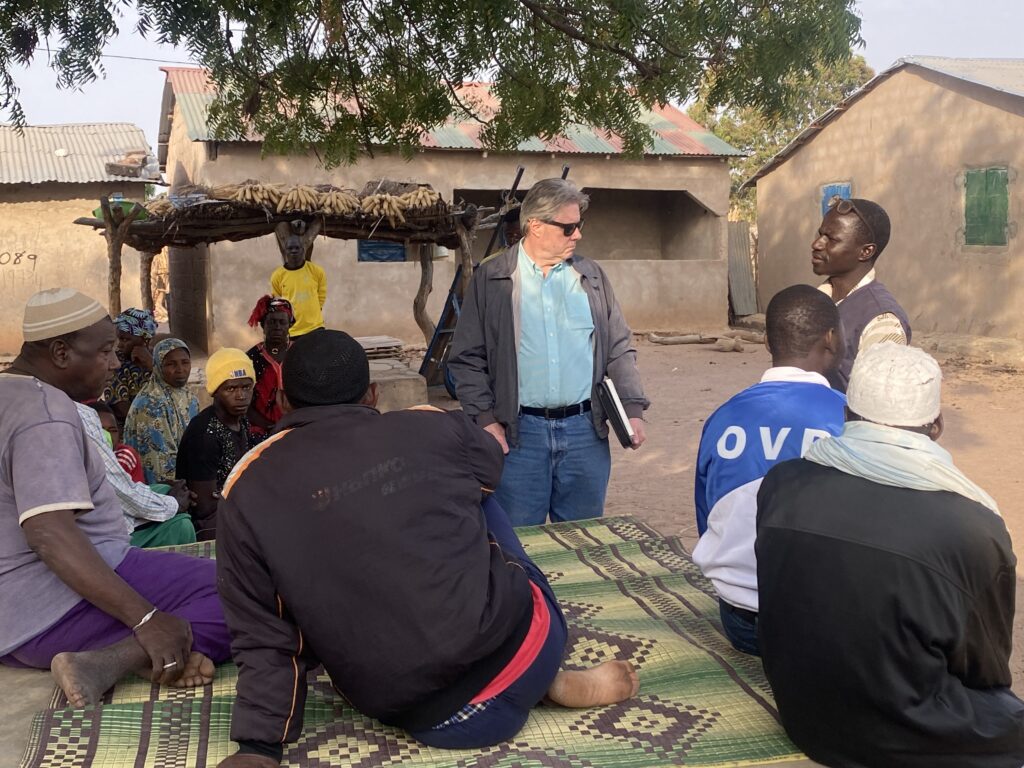
I was contacted by Sheikh Omar Trawalley, project coordinator, on behalf of The Gambian Vice President Muhammad B.S. Jallow and NDMA Executive Director Sanna A. Dahaba. I suspect they reached out to me because I’ve been involved with several projects that concern water issues (but I made sure they understood I’m not a hydrologist, water resource specialist, or water resources engineer). My association with Statistics Without Borders may have also been a factor.
An official statement from The Gambian prime minister says this community-based, disaster risk management approach should meet the goals of the Sendai Framework by 2030. What are the particular goals you’ve been tasked with?
We focus specifically on Priority 4 of the Sendai Framework, “Enhancing Disaster Preparedness for Effective Response and to ‘Build Back Better’ in Recovery, Rehabilitation, and Reconstruction.” The Sendai Framework states, “To achieve this, it is important to promote the resilience of new and existing critical infrastructure, including water, transportation, telecommunications, education, hospitals, and other health facilities, to ensure they remain safe, effective, and operational during and after disasters in order to provide life-saving and essential services.”
Were hydrologists, water resource specialists, or engineers involved in the meetings or consulted as part of the project planning?
The NDMA team included a geographic information system specialist. The NDMA also worked with seismologists to perform subsurface imaging and estimate drilling depths for boreholes. They also used vertical seismic profiling to spot-check the results and ensure drilling didn’t stop too early or go unnecessarily deep.
What was your role in the project, as a statistician?
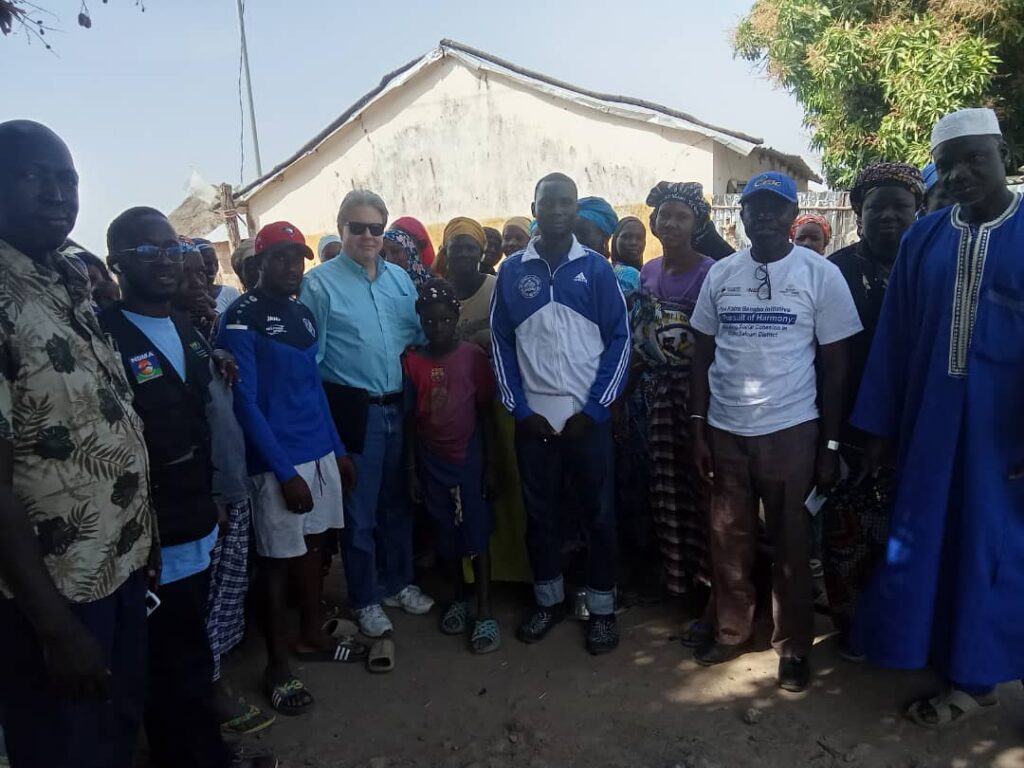
My role was not well defined before the trip. I traveled to The Gambia on the Gambians’ faith that I could contribute meaningfully to this project. I spent three days in Banjul, the capital and population center of the country, meeting with members of the NDMA team (including Dahaba, Trawalley, and GIS technician Omar Sey) to learn more about the project. I also spent two days in rural western The Gambia to meet with leaders and other residents of remote villages to discuss water-related challenges. These meetings clarified the need to collect and provide relevant data to potential funders of these projects. This information included the following:
Summary of the current situation
- Ways the village obtains potable water (water sources or means of obtaining water)
- Cost of obtaining this water (monetary cost, travel time and difficulties, risks, etc.)
- How many people and households would benefit from the proposed borehole and pump (and how many of those people were children)
- The consequences of failing to obtain potable water (the local alternatives and associated problems)
Description of the proposed remedy
- How deep will the new borehole(s) be? How do we know this will reach a long-term, sustainable water supply? How do we know this water is potable? Often, the root problem is actual water scarcity—not having enough supply to meet demand.
- How certain were we that the proposed borehole(s) and pump(s) could meet the recommended minimum daily water requirement of 15 liters per person?
- How will the pump(s) operate (manually, solar power, combination)?
- How water from the borehole(s) would be used:
- Drinking water
- Sanitation
- Hygiene
- Livestock
- Agriculture and farming
- Other
Detailed plan for managing the proposed borehole and pump
- Who will be responsible for decisions about the proposed borehole and pump—during and after construction—and how will they be selected?
- Who will be responsible for decisions about scheduling access to the borehole and pump by the villagers?
- Who will be responsible for decisions about maintenance and repair of the borehole and pump? How will maintenance and repairs be financed (i.e., saving money that would otherwise be spent on water from external sources)?
A detailed, itemized, and inclusive budget with line-item descriptions
- I also suggested removing NDMA personnel time costs from the budget. I suspected potential funders would react adversely to these budget lines and could bias them against funding projects for The Gambia.
Ideas for collecting and organizing this information resulted from these meetings, and we achieved a consensus of thoughts and ideas from the NDMA team and village leaders and residents—a solution by Gambians for Gambians.
How will data collected through this project be used beyond initial funding proposals?
They will be reviewed in the future to determine—and hopefully demonstrate—the efficacy of the project.
Were there moments when statistical thinking helped shift how a problem was framed or solved?
I think there was a point in each of these meetings when we realized how critical information about these projects and villages would be to potential funders, so data collection became paramount.
How will the impact of the project be measured once the work is complete?
Success will be measured by the funding secured and the number of people, households, and compounds given access to reliable, sustainable, and affordable sources of potable water.
What were some of the challenges in helping with this project?
From the Gambian perspective, the remoteness of these villages and lack of funding were the primary challenges. After seven hours on paved roads, reaching each village required an additional 30–60 minutes over rutted dirt roads.
From my perspective, it’s always a bit unnerving to travel to another nation and meet with people about a critical problem or challenge they’re facing without a firm idea about how you can help—but that is the nature of projects like this. The project also required me to learn much about The Gambia—its people, culture, economy, infrastructure, government, languages, etc.
What was the most rewarding part of working on this project?
The project is far from complete, and we have a long road ahead of us. But the most rewarding aspect has been the opportunity to work with our friends in The Gambia. Ultimately, helping these villagers gain access to reliable sources of potable water will be incredibly rewarding for all involved.
How does your role as a statistician continue now that the initial field visits are complete?
I’m assisting with the development of data collection tools and strategies, and I will help when negotiations with potential funders begin.
What advice would you give to ASA members who want to apply their skills to international community-based projects? How can they help?
Learn about challenges faced by a nation or region that is of interest to you or that you connect with on a deep level. Then, contact people who are involved in efforts to address these challenges. Initiate a discussion. Keep your eyes, ears, and mind open as you proceed, and understand that you cannot resolve the challenge. Your task is to help those facing the challenges find ways to resolve them in a way that’ll work for them. We are too often quick to jump in with an approach that worked in the western hemisphere, but ideas like that don’t consider unique conditions of other parts of the world. This lesson from Albert Einstein rings true for these situations: “If I had an hour to solve a problem, I’d spend 55 minutes thinking about the problem and five minutes thinking about solutions.” It’s difficult to overstate the importance of understanding all aspects of a challenge.
Leave a Reply