
Abigail Loe and Olivia McGough received the 2025 Gertrude M. Cox Scholarship. Amstat News caught up with them to discuss what they’ve been doing and how winning the award affected their lives.
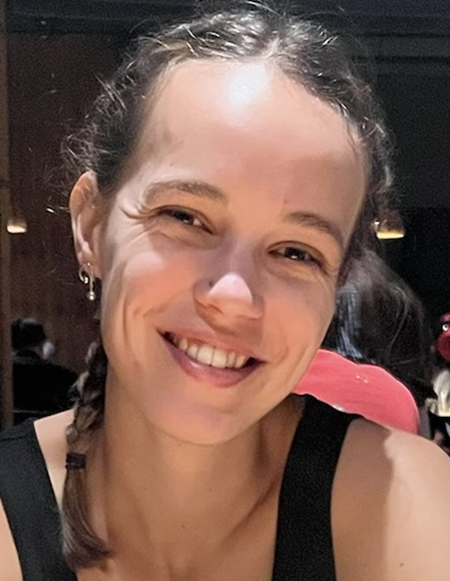
Abigail Loe | University of Michigan
PhD student; starts a tenure-track teaching position at Macalester College in St. Paul, Minnesota, this fall
What are your current research interests?
My theoretical research is in machine learning, survival analysis, and recurrent events. In clinical settings, subjects often experience repeated events of the same type. My work proposes new models to analyze these kinds of data, using tools from computer science and machine learning in new applications for statistical questions. These methods have applications in mental health research, rehospitalization and discharge modeling, and even disciplines as far-flung as political economy.
My applied research is in pulmonary medicine, specifically pulmonary fibrosis. Idiopathic pulmonary fibrosis is a terminal disease with no cure—only treatments that can make patients more comfortable and decrease some symptoms (though these treatments have drawbacks and cannot always be tolerated). I’ve worked on an active clinical trial, programming the statistical analyses, and performed some post-hoc analysis of a different study to find associations between gut microbiota and 12-month transplant-free survival.
In general, I like learning about new tools and thinking about how statistics can help answer questions with a human impact.
How did winning the Cox scholarship help your research or academic career path?
I won the Cox scholarship at a time when I was going through one of the classic cycles of self-doubt many PhD students experience. Knowing that somebody else thought my ideas were interesting gave me a boost of confidence to persevere. Graduate school can sometimes feel very reductive, in that what generally matters is how many high-quality theoretical papers you can produce. The Cox scholarship showed me that other people value the work I do outside of the university environment, which I believe helps me be a better researcher and collaborator.
What or who inspired you to be a statistician?
I remember hearing an NPR story about Gill v. Whitford, a US Supreme Court case about partisan gerrymandering, permutation distributions, and what constitutes extreme. I thought it was a cool use of math to try to prove a point.
What has been the most meaningful part of your graduate school experience?
In the classroom, the most meaningful moments were when I struggled with a concept but worked to reach an “aha” moment. A prime example: I failed my qualifying exam the first time. I spent a year learning, relearning, and connecting concepts. It was exhausting and stressful, and I would have preferred not to be in that position, but after passing the second time, I felt like I had climbed a mountain.
As a researcher, I remember finding an association that complicated the biological story that our collaborators were interested in. It was meaningful to see a survival curve where this one interaction completely wiped out a subgroup from our data. It’s neat to know not many people could have come up with the data analysis algorithm that generated the results … and that it was making a difference in people’s ability to breathe while living with a terminal illness.
Outside the classroom, it’s been time spent with friends in Ann Arbor: game nights; adult recreational sports; craft nights; organizing protests; volunteering at a high school; trips with friends; conference travel; and happy hour with my lab.
Who or what influenced your journey in statistics?
At Carleton College, professors Laura Chihara and Gail Nelson were huge influences. They had different routes to academia, but both were these incredible female role models, researchers, and masterful teachers. My family has also been a constant support and influence in my journey. My sisters have been a great support system and a wonderful gift during grad school. My mom will always be my favorite math professor, and my dad is my favorite person with whom to geek out over machine learning and statistics.
Your citation highlights work that inspires “a healthier and more just world.” How do you see your research contributing to that goal?
To me, a healthier and more just world is understanding the interconnectedness of our everyday life with statistics (which is how humans go about making sense of randomness) and trying to make a positive difference within that system. I love seeing how statistics and math informs everyday life and vice versa. In college, it would be me pointing out mathematical connections in volleyball practice (something my coaches and teammates would lovingly roll their eyes about) or cracking linear algebra jokes with friends. As a graduate student, I love seeing patterns of missing data or survival bias in everyday health news—or thinking about weighted estimators in survey data and how that affects our understanding of political opinion, even though I don’t work in survey research.
What are you most excited about working on next?
I’m excited to get back into the liberal arts environment and start teaching at Macalester! College was such a formative and exciting time for me. I can’t wait to be part of that journey for other students and to collaborate with truly awesome colleagues.

Olivia McGough | University of Washington
PhD statistics student
What are your current research interests, and what are you most excited about working on next?
Since joining the statistics department at the University of Washington and working with Daniela Witten, my primary research focus has been conditional selective inference. I’m especially interested in projects motivated by how statistics are practiced, where common data analysis workflows exhibit undesirable frequentist properties under a selective inference lens. Along these lines, I’m currently working on a problem motivated by a common procedure in two-stage least squares models. I’ve been able to identify where the procedure breaks down theoretically. I’m excited to develop a solution with selective inference methods and to contribute more broadly to statistical methodology that bridges theory and application.
What or who inspired you to be a statistician?
The idea of research and an academic career has always appealed to me because my dad is a professor, and growing up, I admired how much he enjoyed his work and the passion he had for research and learning. Like him, math was always my favorite subject in school and what I ultimately studied in college. However, near the end of my undergraduate degree, I realized during a research project that I was most excited by mathematics when it was applied to real-world, data-driven problems. That’s what inspired me to apply to both mathematics and statistics PhD programs, and in the end, it was Daniela Witten who convinced me to make the switch from mathematics to statistics when I met her at the UW Admitted Students Day (she was right, per usual).
What has been the most meaningful part of your graduate school experience?
UW has a great statistics program, and I’ve really enjoyed my courses here, but what stands out for me in our department is the people. I’ve met and worked with some wonderful graduate students, and my experience here has been especially positive because of my advisers. I started working with Daniela Witten and Daniel Kessler at the end of my first quarter at UW, and I knew immediately that I wanted to continue working with them as long as they’d let me. They are both incredibly smart, but what I appreciate most is how invested they are in their students, both in supporting us and in pushing us to grow as researchers. Working with them has been the most defining part of my time at UW. It’s made graduate school engaging and rewarding.
Who or what influenced your journey in statistics?
In many ways, my journey in statistics has been shaped by the positive mentorship I have experienced throughout academic life—beginning with my parents helping me with math homework growing up. Then, tutors at drop-in sessions in college, professors with welcoming office hours, and my research advisers in both undergraduate and graduate school. These mentors made academia more accessible to me in two important ways—in a literal sense by taking the time to help me understand the material and, in a broader sense, by creating an encouraging environment and a sense of belonging in academia, even when I felt intimidated.
Your citation emphasizes mentorship and inclusion. How do you hope to inspire or support other women pursuing statistics?
I truly don’t think I would be in graduate school right now if it weren’t for the support of the mentors I’ve mentioned in my other responses. Because of that, it’s important to me to be part of that same kind of community for statistics students early on in their careers. I recognize that statistics and academia aren’t for everyone, and that’s okay. But I think it’s critical to send the message that academia at large can be a space for anyone that wants to be here, regardless of background or identity. Mentors in the field play a pivotal role in sending that message. Because this kind of encouragement and support had such a profound impact on my academic experience, I look forward to passing it on to future mentees.
How did winning the Cox scholarship help your research or academic career path?
I feel fortunate to have received the Cox scholarship. In addition to the financial support that allows me more flexibility to focus on my research, the recognition is incredibly encouraging. It feels like an affirmation that the work I have done so far is meaningful, and it reinforces my commitment to pursuing an academic career.
Leave a Reply