
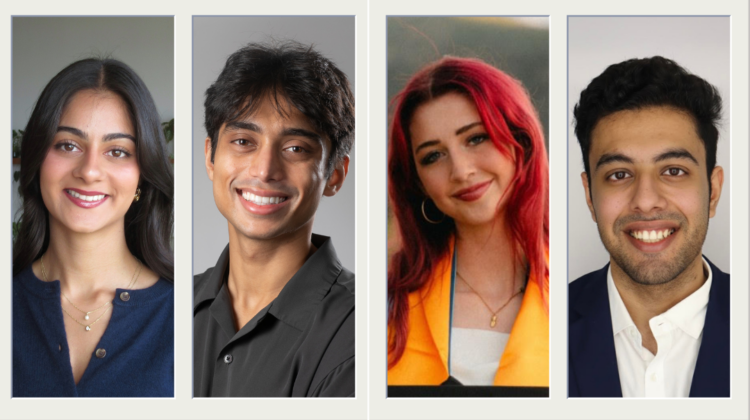
Riya Kalra, Columbia University Mailman School of Public Health; Sripad Karne, Columbia University; Kaylie Stuteville, New York University; and Raj Trikha, New York University
The Hackathon at The AI Summit New York brought together 40 participants for an eight-hour, data-driven challenge December 9–11, 2025. It allowed young talent to showcase their skills, network with industry experts, and connect with leading global organizations, regardless of academic background.
To compete effectively, participants needed the following skills:
Technical Skills
- Programming: Proficiency in languages such as Python or Java
- AI/ML Knowledge: Understanding of machine learning concepts and frameworks
- Data Analysis: Skills in data manipulation and visualization
Domain Knowledge
- AI Agents: Awareness of how AI agents operate
- Problem-Solving Skills
- Analytical Thinking: Ability to evaluate problems and devise innovative solutions
- Creativity: Openness to developing unique AI applications
The competition featured the following two categories:
Best App for Agentic AI: Create an AI application that embodies autonomy, adaptability, and decision-making at its finest. Whether revolutionizing workflows, enhancing user experiences, or driving intelligent automation, this category was about creating applications that empower AI to act as a true agent of change.
Best App for Computer Vision: Create an AI application that transforms how machines perceive and interpret the world. From advanced image recognition to real-time video analytics, this category highlighted innovations that harness the power of computer vision to solve complex challenges and unlock new possibilities.
The hackathon selected 40 competitors from more than 600 applicants. Participants attended a Day 0 Workshop with a show-and-tell of the Dell Pro Max with GB10—a compact, powerful AI developer workstation/appliance designed for local AI inferencing and AI development.
Judging Criteria
- Technology: How technically sound was the use of the technology?
- Efficiency: How well did the project use technology? Was there a more efficient way to accomplish the same outcome?
- Practicality: Was the project practical from a business perspective?
- Scalability: Is there a demand for this solution in the chosen market?
- Impact: How impactful was the project? Did it affect many people with low impact or a few people with profound impact?
Top Contestants and Their Winning Solutions

Riya Kalra is a master’s student in biostatistics at Columbia University Mailman School of Public Health. She developed RxGuardian, a computer vision-based medication verification and safety system and was the overall winner and Computer Vision Category winner. She received a Dell workstation setup, premium laptop, and NVIDIA–Dell swag box. She also earned a Dell Pro Max Ambassador Program spot.
Her project was motivated by an incident in which Kalra’s grandmother, more than 9,000 miles away in Gujarat, India, was unable to distinguish between visually similar medications after accidentally dropping her pills. The experience highlighted a common and under-addressed problem in medication safety: When pills are removed from labeled packaging, patients and caregivers often lack reliable tools to verify medications and prevent dangerous mix-ups—particularly in remote or time-sensitive situations.
RxGuardian was built on Dell Pro Max hardware powered by the NVIDIA Grace Blackwell GB10 GPU. The system uses GPU-accelerated computer vision, combining SAM2-based image segmentation, multi-view visual inference, and OCR-driven validation to identify pills and verify them against structured medication data. Kalra implemented CUDA-based parallelization across segmentation, inference, and text recognition pipelines, reducing pill-level verification latency from seconds to milliseconds and enabling real-time safety checks.
Throughout the hackathon, Kalra worked closely with mentors from NVIDIA and Dell Technologies, incorporating feedback to improve robustness under real-world conditions such as varied lighting, partial occlusion, and cluttered backgrounds. A key design focus was uncertainty-aware reasoning, ensuring the system communicated confidence levels and flagged potential drug-drug interactions, rather than providing false reassurances.
RxGuardian is a scalable foundation for applications in elder care, emergency response, clinical intake workflows, and medication adherence monitoring. The architecture supports future extensions, including prescription label OCR, voice input, and integration with clinical data systems.
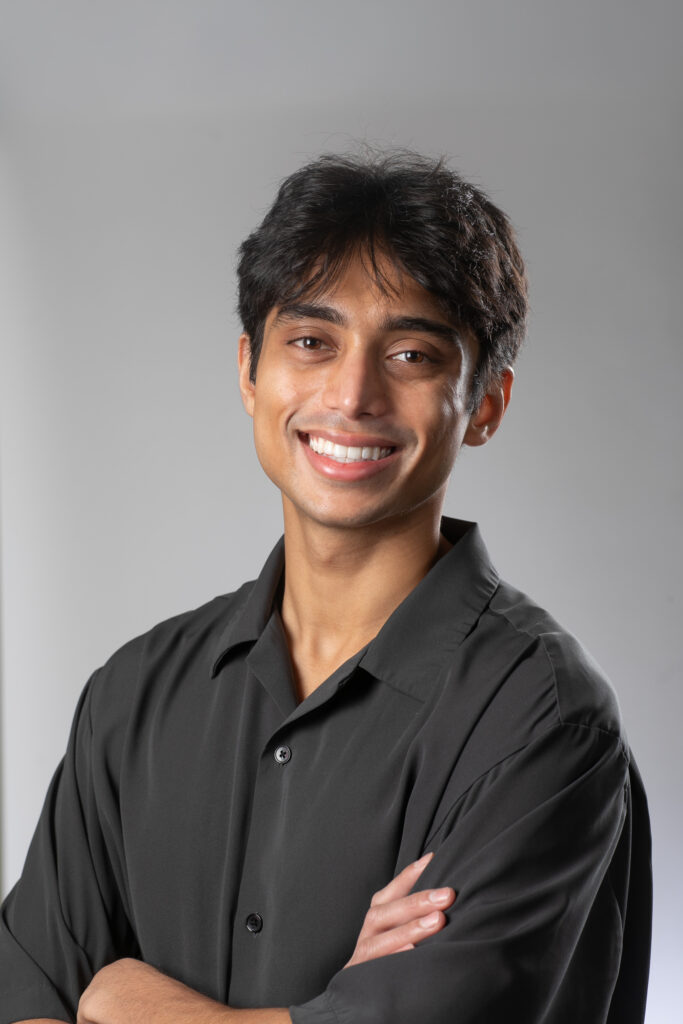
Sripad Karne is a master’s student at Columbia University and winner of the Agentic AI category. He received a Dell Pro Max premium laptop for developing Guardian AI, a multi-agent AI system designed to reason over video streams and support safety-critical decision-making. Guardian AI was implemented as an agentic system, composed of multiple task-specialized agents, each responsible for a distinct function within the pipeline. These included agents for computer vision-based video understanding, temporal event localization, safety risk assessment, and visual evidence extraction.
The system processed live video input, identified potentially hazardous situations, and generated structured explanations tied to specific visual evidence. A human-in-the-loop interface allowed users to query the system and guide its focus, enabling iterative refinement of judgments rather than fully automated decisions. This design highlighted the practical challenges of building agentic AI systems that are interpretable, responsive, and aligned with human oversight.
From a technical perspective, the project prioritized end-to-end integration over model novelty. Karne focused on wiring together perception, reasoning, and interaction components into a working system under strict time constraints, using GPU-accelerated vision and compute on the GB10 platform to enable real-time processing. Throughout the hackathon, the architecture was iteratively refined through discussions with mentors from Dell Technologies and NVIDIA, with feedback shaping both system behavior and evaluation criteria.
While Guardian AI was developed as a prototype within a limited development window, it demonstrated how computer vision, agent-based reasoning, and system-level design can be combined to build AI systems that go beyond isolated models to become actionable, explainable tools. More broadly, the project reflects Karne’s interest in building AI systems in which design, integration, and iteration matter as much as the underlying models.
The project was recognized by judges for its technical depth, clarity of architecture, and strong alignment with core agentic AI principles.

Kaylie Stuteville is a graduate researcher at New York University and was runner-up in the Computer Vision category. She received a Dell + NVIDIA Swag Box.
Kaylie developed the first working prototype of Emotion Trace QA, an emotion-aware gameplay UX analysis system that connects computer vision, sentiment analysis, and gameplay telemetry to better understand how players emotionally respond to in-game events.
Built on the Dell Pro Max with GB10 hardware, the prototype draws on Stuteville’s ongoing research into emotional responses in interactive systems. Throughout the event, she collaborated closely with mentors from NVIDIA and Dell Technologies and incorporated continuous feedback from fellow participants, refining both the technical pipeline and the system’s usability for development teams.
Emotion Trace QA is designed as a support tool for game developers and QA teams, helping surface patterns in player experience that are often difficult to capture through traditional methods such as manual observation, video review, or post-play interviews. The system correlates gameplay events with player emotion in real time. It also provides a visual debugging interface for inspecting moment-to-moment experience and generates AI-assisted UX and QA reports. A key design goal is enabling teams to privately fine-tune perception models on their own game data, preserving proprietary content while improving model relevance.
Given the limited development window, the perception model in this prototype was initially fine-tuned on Fortnite gameplay, with a focus on enemy interactions, enabling targeted analysis of player behavior and emotional response during combat encounters. The underlying framework is fully generalizable and designed to extend across game genres, mechanics, and player data sets.
Looking ahead, the project will integrate additional perception models within the NVIDIA AI software stack, expand emotional feedback channels such as voice and behavioral cues, and develop more advanced temporal modeling tools for comparing playtest sessions and surfacing design friction.
The NVIDIA AI and Dell Technologies hardware and mentorship enabled rapid prototyping and technical exploration.

Raj Trikha, a master’s student in computer science at New York Univeristy, was a top three finalist in the Computer Vision category for AisleAI, a multi-modal autonomous vision agent.
Trikha chose to tackle a costly, operationally difficult problem to manage at scale: liability risk and inventory loss in superstore environments.
AisleAI was designed to operate in complex retail environments typical of big box stores. Rather than focusing solely on object detection, the system reasoned about aisle-level context in a way similar to a human floor manager. The prototype focused on three practical concerns: detecting chemical spills and potential cross-contamination risks; identifying deviations from expected planogram layouts; and flagging misplaced frozen items in ambient aisles before spoilage occurs.
To support this functionality, Trikha implemented a fully local, edge-first pipeline combining computer vision and vision-language models, including YOLOv8, CLIP, and large language models like Qwen-7B. A central design constraint was avoiding cloud-based video transmission. The system was deployed entirely on NVIDIA’s Grace Blackwell GB10 platform.
The unified memory architecture and on-device compute capabilities made it possible to run a multi-model reasoning pipeline locally, preserving data sovereignty while enabling real-time analysis. Trikha described the hackathon as a valuable exercise in building and deploying agentic vision systems under real hardware constraints. The project benefited from the mentorship and feedback of judges and mentors from Dell Technologies and NVIDIA, which helped refine both the system’s scope and real-world applicability.
Leave a Reply