
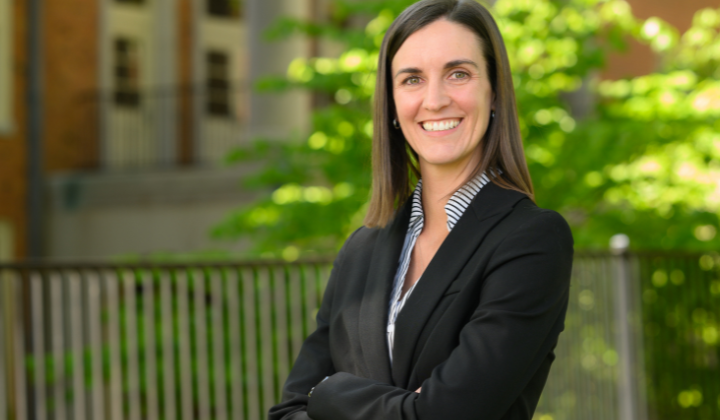
This month, we’re featuring Staci Hepler, whose work spans teaching, research, and service—strengthening both the statistical community and the next generation of statisticians.
What is your current role or area of expertise in statistics?
I am an associate professor and associate chair of the department of statistical sciences at Wake Forest University. This semester, I’m also serving as interim chair while ours is on sabbatical, and it’s been a fun learning experience.
My research focuses on spatial statistics—with applications in public health and environmental science—and Bayesian computing. I’ve been funded on National Institutes of Health projects since 2018, focused on the opioid epidemic, including development of multivariate spatial models for small-area estimation. It’s really interesting work.
What influenced your decision to become a statistics professor?
When I was an undergraduate student at Shawnee State University, math education was my major. I planned on being a high school math teacher and perhaps coaching soccer and track, as those were things I was interested in.
I was working in a math tutoring center and found information about REU summer programs at Miami University of Ohio. I applied and was accepted. Prior to the REU, I hadn’t taken a statistics class yet, so I was in a number theory research group. Whenever they brought in speakers, I realized the statisticians were the most interesting. Statistics spoke to me.
And it was during that program that I met Jack Miller, a professor at Ohio State. Jack really sold me on Ohio State, and I went for my post-grad work in statistics. While there, I became one of their teaching assistants, and that experience truly influenced my career.
Teaching and doing student-focused work were so important to me. This experience helped me realize I truly wanted to work at an institution like Wake Forest—one that equally values teaching and scholarship. Both were non-negotiable for me; I couldn’t give up either one.
What are some of your most rewarding professional experiences?
Mentoring! I’ve been at Wake Forest for 11 years, and at this point, many of my former undergraduates have finished their PhDs or are close to finishing at other institutions. Some have gone on to start their own companies and are achieving amazing things.
What I’m most proud of is having played some role in their trajectory and seeing where they are now. I recently saw that several of my former students, now in graduate programs, have won student paper awards from different ASA sections. It’s awesome to see their success within ASA and their growing involvement in the community.
On a more personal note, there are two professional achievements I’m very proud of: Winning the Early Investigator Award from the ASA Section on Statistics and the Environment and the Woodroofe Award from the Caucus for Women in Statistics and Data Science. These were especially meaningful because being recognized by your peers and the broader statistics community is both humbling and exciting.
Tell me about a professional challenge you met head-on.
I’m one of the faculty members in the inaugural Department of Statistical Sciences at Wake Forest—and it’s been amazing! When I joined Wake Forest, I was in the department of mathematics and statistics, and my colleagues were wonderful.
As statistics experienced rapid growth, it made sense to separate and form our own department. In doing so, I experienced a unique challenge—it’s not often in academia that you get to start something new from scratch. It was a responsibility we as faculty did not take lightly, and it was incredibly rewarding to play such a large role in creating a department and watching it grow.
Are you a member of an ASA chapter, section, or committee?
Yes. Two sections I’ve been most involved in are the Section on Statistics and the Environment and the Health Policy Statistics Section. As a graduate student, I was fortunate to win a student paper award from the Section on Statistics and the Environment, and I’ve been involved ever since. More recently, I served a two-year term as treasurer and secretary for that section.
I’ve also been involved with the Health Policy Statistics Section. While I don’t currently hold a formal role, I served on the executive planning committee for the 2025 International Conference on Health Policy Statistics, a joint conference of ASA and the HPSS section.
I’m currently vice chair of the ASA Committee on Membership Recruitment and Retention and a former chair of the Gertrude Cox Scholarship Committee. That experience was mind-blowing—it’s incredible to see how phenomenal the next generation of female statisticians is.
What have you learned through your ASA service?
My experiences with ASA sections and committees were among my first leadership opportunities. At this point in my career at Wake Forest, I’m taking on more leadership roles, and those early experiences were incredibly valuable.
Serving in sections and committees provided a great introduction to leadership in the profession. These groups are supportive environments to develop skills like communication and collaboration—key ingredients for effective leadership.
Any career advice?
I was just talking with my colleague Lucy D’Agostino-McGowan, who is very involved with the ASA, about how work-life balance doesn’t necessarily exist—but we can strive for “equilibrium.”
Something is always getting more of your time and energy than something else, and that’s okay. Instead of thinking about balance, think in terms of equilibrium. Day to day, week to week, and semester to semester will look different. No single day will feel perfectly balanced, so it’s better to think about it in terms of the “long run.”
Leave a Reply