
Penny S. Reynolds
For National Pet Month, we celebrate an overlooked but revealing aspect of several well-known statisticians—their pets. Pets often accompanied their owners during long hours of thinking, calculation, and writing, and sometimes even acted as research subjects.
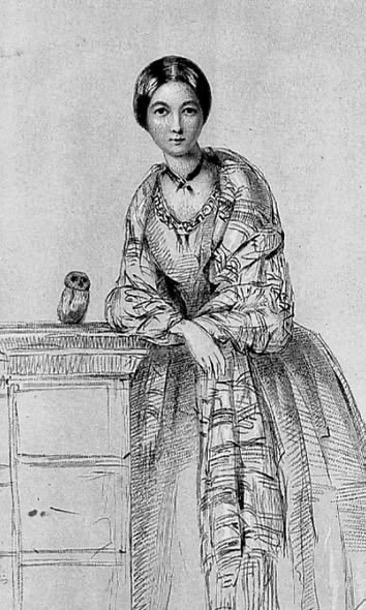
Florence Nightingale (1820–1910)
Best known as a pioneer of statistical graphics and nursing reform, Florence Nightingale loved animals. Before leaving for Crimea, she had a pet owl named Athena and a cricket named Plato (later eaten by Athena). During the Crimean War, Jimmy the tortoise, a pet in the British base hospital in Scutari, used to follow her about on her rounds. Athena (stuffed) and Jimmy’s shell are on exhibit in the Florence Nightingale Museum in London. Upon leaving Crimea, Nightingale was presented with a puppy as a gift from the soldiers. However, she also favored cats and owned more than 60 during her lifetime, mostly Persians named after famous people of the day, such as Bismarck and Gladstone. Inky cat paw prints can be seen on some of her correspondence.

Francis Galton (1822–1911)
Francis Galton believed that keener sensory perception was related to higher intelligence, and he developed the Galton Whistle to test the upper limits of hearing. He tested human hearing at his Anthropometric Laboratory, and he wandered around the London Zoo blowing his whistle to test the hearing of the animals, much to the annoyance of the lions. Strangely, he also thought the ideal cat would be deaf. His suggestions for developing his new and improved cat prompted an anonymous 1885 The New York Times editorial to describe him as “one of the most ingenious and yet useless scientific persons now living.” Galton had an albino Pekingese dog named Wee-Ling, one of the puppies produced in Karl Pearson’s dog breeding research program.

James Clerk Maxwell (1831–1879)
A brilliant and pioneering physicist, Maxwell came up with the idea of describing statistical regularities underlying molecular motion from concepts adapted from Adolph Quetelet’s “social physics.” Maxwell had many dogs during his lifetime, all terriers called Toby. A dog would always lie at his feet while he was working, and Maxwell would talk to it when he was trying to sort out his thinking. You can see a statue of Maxwell with one of the Tobys on George Street in Edinburgh, Scotland.

Karl Pearson (1857–1936)
Statistician Karl Pearson thought results from animal breeding experiments could legitimize the claims of eugenics. He boasted in 1913 that he had created a “new race” of dog, consisting of albino Pekingese-Pomeranian crosses he claimed were closer to “British racial standards.” He based his conclusions on coat color and biometric skull measurements. The study of cephalic indices and trait distribution curves were staples of physical anthropology for decades and contributed to pseudoscientific arguments supporting biological racism.
For details, download the references.
Leave a Reply