
Yehenew Kifle, University of Maryland
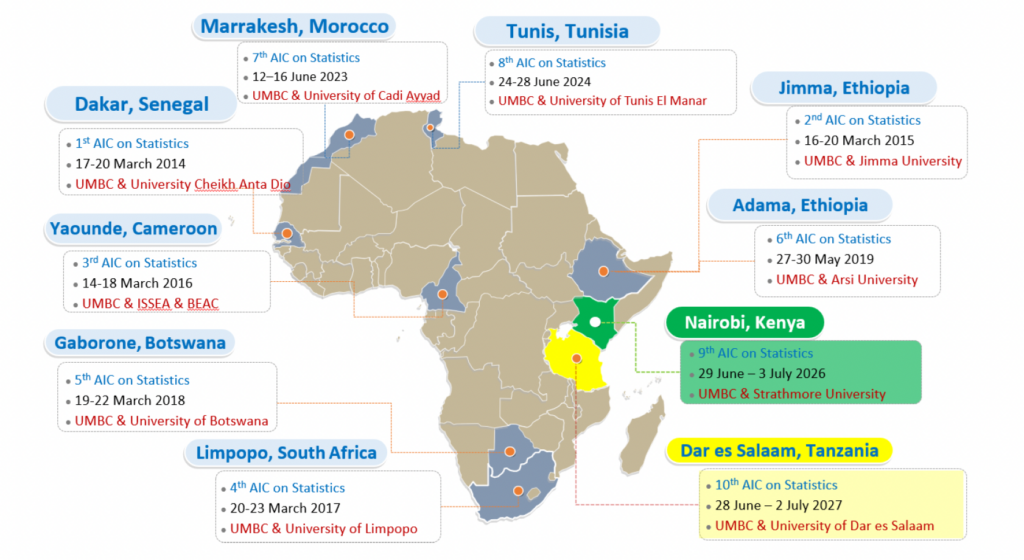
The locations and timeline of the African International Conference on Statistics highlight its rotating model across the continent.
The African International Conference on Statistics has become a powerful continent-wide platform to advance statistical science, build human capital, and strengthen academic institutions in Africa. Since its small-scale launch in 2014, AIC has evolved into a sustained engine for capacity building, collaboration, and long-term academic development.
The conference’s strength lies in its design. Its rotating, Africa-centered model—spanning countries such as Senegal, Ethiopia, Cameroon, South Africa, Botswana, Morocco, and Tunisia—ensures access to global statistical engagement is not confined to a single location. Instead, it brings opportunity directly to local African institutions, enabling universities across the continent to host, lead, and benefit. This structure reduces geographic barriers while fostering ownership and institutional visibility.
At the core of AIC is a strong emphasis on training and building the skills of the next generation of African statisticians. Each conference integrates pre-conference workshops designed for graduate students and early-career faculty, providing hands-on exposure to modern statistical methods and data science tools. AIC also promotes inclusive academic development, including initiatives aimed at empowering women in statistics through leadership and professional development workshops. These efforts expand access, strengthen networks, and contribute to a more inclusive statistical community. These opportunities are particularly impactful in settings where access to advanced training is limited.
This commitment is further strengthened in the 2026 conference, which will feature a specialized workshop titled Artificial Intelligence for Advanced Statistical Analysis. Supported by the American Statistical Association and Institute of Mathematical Statistics, the workshop is designed for African statisticians, particularly PhD students and early-career faculty. This initiative reflects AIC’s forward-looking vision of equipping African researchers with the tools needed to engage in contemporary statistical topics.
AIC’s contributions extend beyond training into long-term academic investment. Each conference supports host African institutions through the donation of advanced statistics textbooks, strengthening graduate-level teaching and research infrastructure. This ensures the benefits of AIC persist well beyond the conference itself.
Moreover, the most compelling measure of AIC’s success is its contribution to academic pathways and leadership development. Through mentorship and sustained collaboration, many participants have secured fully funded PhD opportunities at leading institutions around the world. Importantly, several of these scholars return to African universities as faculty and researchers, contributing to local capacity and creating a multiplier effect across the continent. AIC is thus helping to build a self-sustaining pipeline of highly trained statisticians.
Equally significant is AIC’s role as a global connector. Through partnerships with organizations such as the ASA and IMS, the conference has facilitated joint research, co-supervision of graduate students, and long-term institutional collaboration. A notable strength is the active involvement of African statisticians in the diaspora, who take leadership roles in organizing increasing invited and keynote speakers based within Africa, ensuring that emerging statisticians can engage with and be inspired by strong role models.
Funding from the ASA and IMS is primarily directed toward strengthening conference infrastructure, supporting local accommodation for participants from Africa, and running conference workshops. This support is especially focused on participants from the host country and the broader region, where the impact on access and capacity building is greatest. While AIC’s long-standing tradition is that invited speakers cover their own international travel expenses, the conference provides local accommodation for a select number of international invited speakers, ensuring both broad participation and high-quality scientific engagement. This partnership has enabled AIC to significantly strengthen participation across the continent, as evidenced by the strong and growing registration for AIC 2026. The conference continues to attract participants from East, West, North, and Southern Africa, demonstrating an expanding continental footprint and increasing engagement.
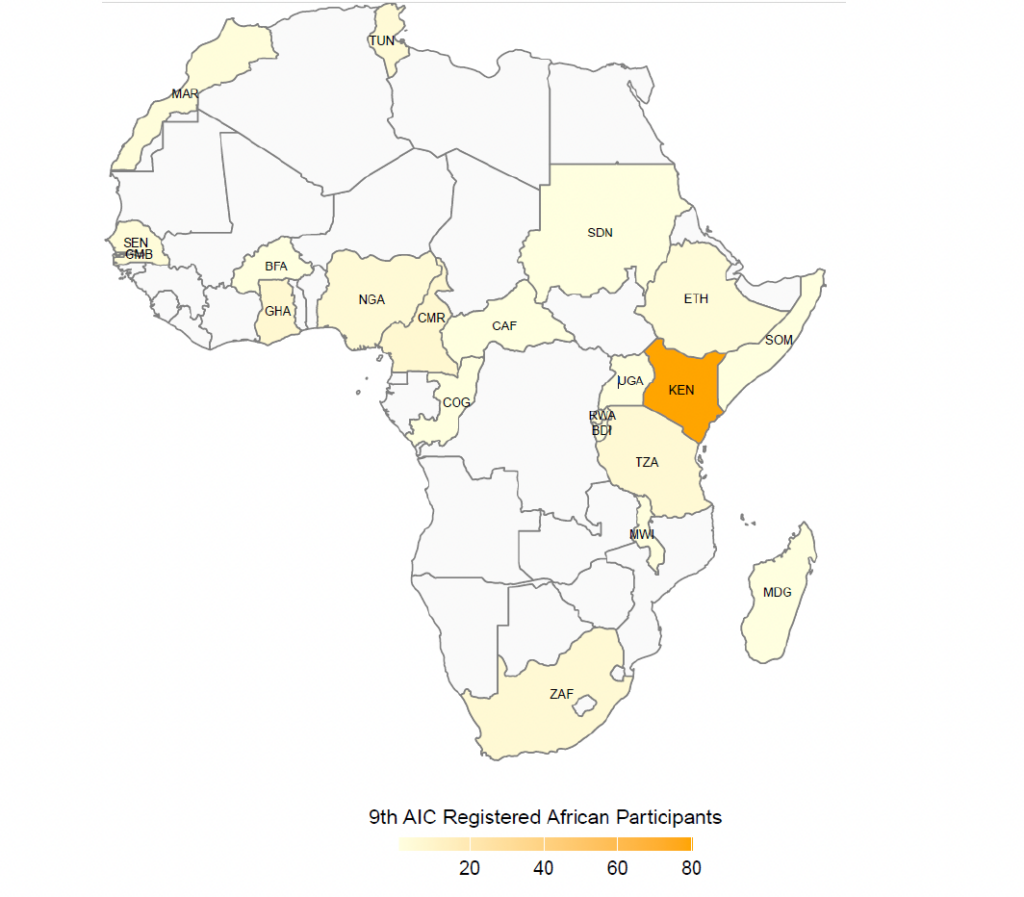
African participants registered for the 9th AIC as of April 2026.
Beyond individual development, AIC has contributed to institutional transformation. Collaborations initiated through the conference have led to joint PhD programs, faculty exchanges, and sustained partnerships between African and international universities. These outcomes underscore a central point: AIC is not merely a conference; it is a platform for building durable academic ecosystems.
Looking ahead, the 2026 AIC at Strathmore University in Kenya represents a significant milestone. With strong participation from across the continent, targeted training initiatives, and continued international collaboration, AIC is well positioned to deepen its impact in graduate education, research, and regional integration.
AIC offers a compelling model for how scientific initiatives can drive meaningful change. Its achievements are tangible: training early-career statisticians; strengthening institutions through resources and partnerships; building global research networks; promoting inclusivity; and developing a growing pipeline of African statistical leaders. Overall, the story of AIC is not one of limitation, but of progress, investment, and transformation. It reflects what is possible when a conference is designed not just to convene, but to build.
While AIC has made strong progress, there is still more to be done. We invite all statisticians, especially those with strong connections to Africa, to join future AIC conferences and contribute to building a lasting and transformative impact.
For additional information, contact the conference chair, Yehenew Kifle.
Editor’s Note the 2026 conference set to happen this summer has been rescheduled for January 2027 due to the Ebola outbreak. Visit the AIC website for details.
Leave a Reply