
Notes from the Dionne Price Public Lecture at the University of Kansas
Megan Murphy, ASA Communications Manager
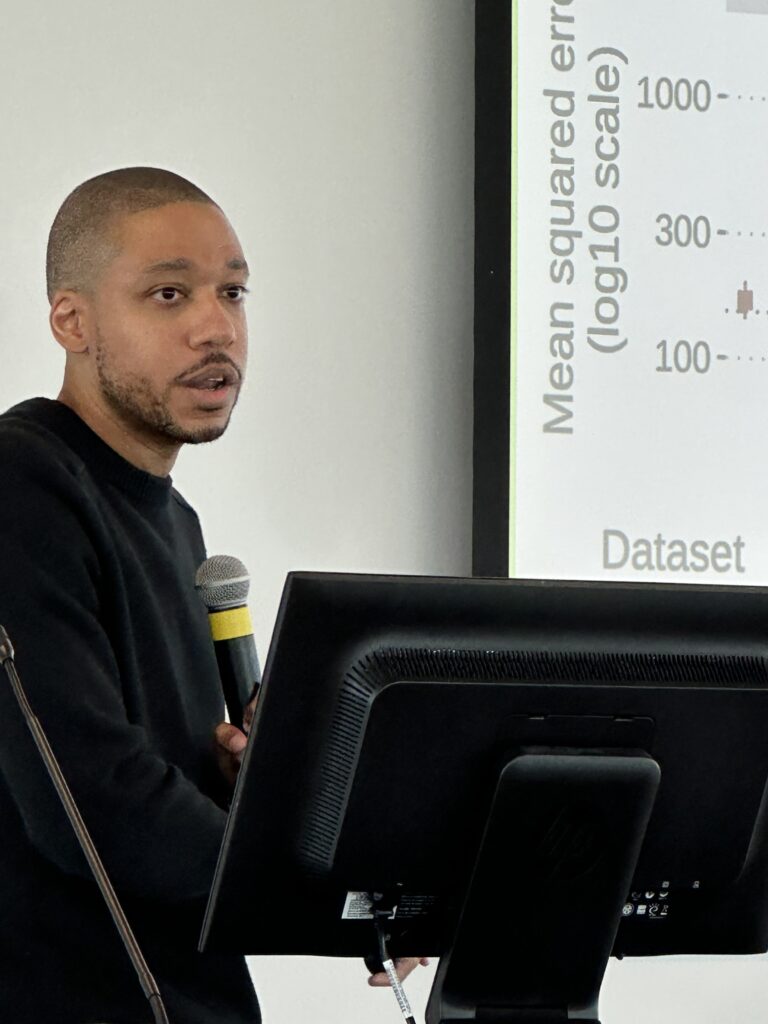
During the Dionne Price Public Lecture, Lorin Crawford highlights the vital role statisticians play in improving lives.
Photo by Rachel Mills/ASA
What does it look like to bring AI into cancer research? Lorin Crawford, principal researcher at Microsoft Research, shared the answer to that question while giving the Dionne Price Public Lecture April 21 at the University of Kansas. He also made the case that statisticians are essential to making AI work.
The lecture opened with remarks from ASA Executive Director Ron Wasserstein, who honored Price, the former ASA president who passed away in February 2024. After a brief introduction from Matt Mayo, department of biostatistics and data science chair, the focus shifted to Crawford, co-leader of Project Ex Vivo, a joint cancer research collaboration between Microsoft and the Broad Institute.
Project Ex Vivo: Building an End-to-End System
For Crawford, the answer to the question means building something that didn’t exist—a pipeline that runs from computational modeling to lab experiments to patient care and back again.
That pipeline is Project Ex Vivo. The team (statisticians, mathematicians, computer scientists, AI and ML experts, as well as experimentalists) generates massive datasets from tumor samples to map how cancer cells interact within their environment, then uses those datasets to train AI models to predict
outcomes and guide drug discovery. The goal is to move from understanding cell states to predicting drug responses—and, eventually, identifying treatments that effectively kill cancer cells while minimizing harm.
Rethinking Cancer Models
That vision reflects a broader shift in how scientists understand and treat cancer.
Traditionally, oncologists have relied on a patient’s DNA to guide treatment decisions—matching specific mutations with targeted therapies. While this approach has led to breakthroughs, it has a major limitation: Many patients do not have actionable mutations that can point doctors toward a clear course of treatment.
Crawford’s work instead focuses on cell state—a concept rooted in how genes are expressed (via RNA) and how cells behave within their environment. Unlike DNA, which is static, RNA reflects the real-time activity of a cell. This makes it a more dynamic way to track how cancer develops and changes over time.
Whether ensuring drug safety or guiding AI toward better cancer therapies, statisticians play a central role in improving lives.
Where Statistics Comes In
Despite the prominence of AI in this work, Crawford demonstrated that building a better model is ultimately a data problem.
Early experiments showed that even sophisticated AI models struggled to generalize, especially in “zero-shot” settings (making predictions on entirely new data). Surprisingly, adding more data did not always improve performance. In some cases, models reached a saturation point, learning little from additional data.
This is where statistical thinking becomes essential. Statisticians help answer critical questions: How much data is enough, and how do we train these models using statistical knowledge? Crawford’s team analyzed millions of cells and found model performance often reached a plateau after using only a fraction of the data. To study this effect, they used down-sampling, reducing the dataset size in a controlled way to see when performance stopped improving.
Crawford made clear that statisticians are not the support staff for AI teams. Addressing the statisticians in the audience, Crawford said, “You’re more than a strategic architect—you’re driving the cycle.” In the age of machine learning and large language models, statisticians are the key to driving the system.
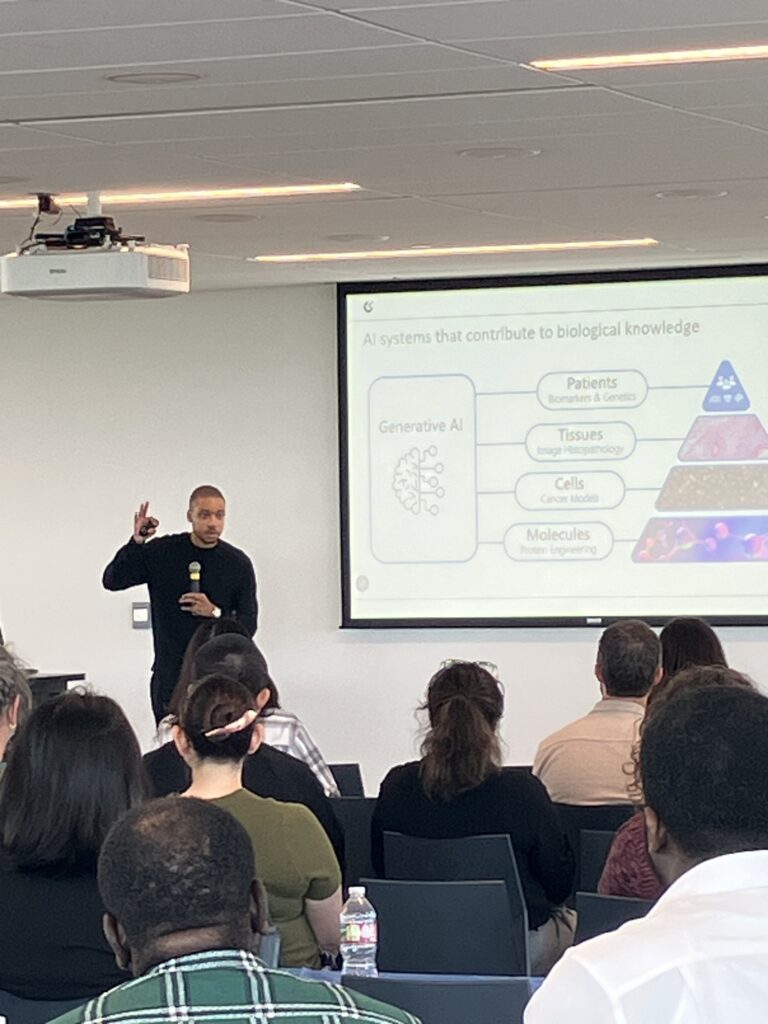
Photo by Rachel Mills/ASA
A Legacy in Motion
When asked what he hopes to report on if he gives this talk again in three years, Crawford pointed to both scientific and cultural progress: more effective cancer treatments; greater confidence in AI systems; and a statistics community that is more visible, influential, and outward-facing.
That message echoes Dionne Price’s own. “My greatest accomplishment,” she once wrote, “is the daily knowledge that my statistical leadership and expertise positively contribute to ensuring the efficacy and safety of drugs and therapeutic biologics for the public.”
Whether ensuring drug safety or guiding AI toward better cancer therapies, statisticians play a central role in improving lives. And as Crawford made clear, that role is only becoming more important.
The ASA would like to thank its donors for supporting the Dionne Price Public Lecture.
Leave a Reply