
Siddhesh Kulkarni and Julia Cai
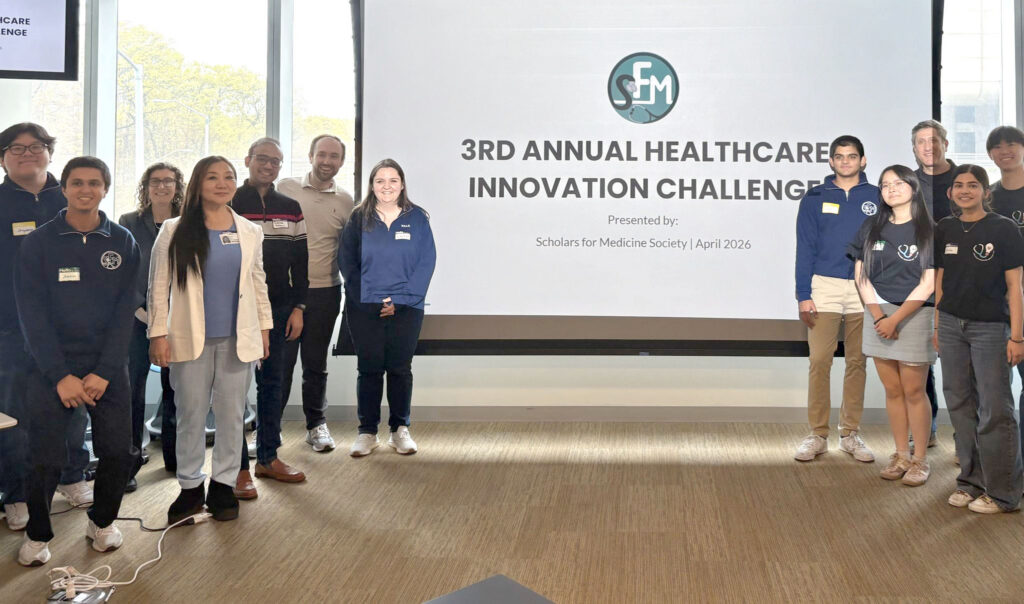
Mentors and organizers, from left, include Stephan Jung, Aman Mistry, Julia Bear, Julia Cai, Siddhesh Kulkarni, Matt Miller, Lauren Baguette, Siddhant Desai, Jonathan Kornreich, Anh Le, Alex Wang, and Alisha Raiker.
Student-led innovation challenges are important spaces where interdisciplinary thinking meets real-world problem solving.
The 3rd Annual Healthcare Innovation Challenge, hosted by Stony Brook Scholars for Medicine at Stony Brook University, brought together nearly 120 students from diverse academic backgrounds to tackle the theme “Restore & Rehabilitate: Rebuilding Function, Independence, and Life.” Participants worked in teams to develop innovative solutions within a timeframe, moving rapidly from idea generation to structured proposal. The format encouraged creativity and emphasized feasibility, impact, and communication.
The day began with a keynote address by Anne Felicia Ambrose, chief of neurorehabilitation at Stony Brook University. Her perspective on the growing need for scalable, patient-centered rehabilitation solutions set the tone for the projects that followed.
Students worked throughout the day, culminating in presentations evaluated by a panel of judges representing clinical medicine, statistics, engineering, and entrepreneurship. The judging criteria emphasized innovation, feasibility, impact, and scientific rigor, reflecting the multifaceted nature of healthcare problem-solving.
From a statistical and translational perspective, one of the most notable aspects of the event was how quickly students adapted to the constraints of real-world problem-solving. Within a matter of hours, teams moved from broad ideas to structured proposals, often incorporating elements of digital health, patient-centered design, and data-driven thinking.
A noticeable pattern was the prevalence of wearables and app-based solutions, reflecting current trends in healthcare innovation. While many of these ideas demonstrated technical creativity, the strongest teams distinguished themselves through clarity, particularly in explaining how their solutions would be used and by whom.
This distinction highlights an important lesson for early-stage innovation: The value of a solution lies not only in its technical sophistication, but in its ability to inform or improve decision-making. Teams that were able to connect their ideas to a clear use case—whether for patients, clinicians, or healthcare systems—presented more compelling and realistic proposals.
Another aspect of the event was the level of engagement from participants. Students actively sought feedback from mentors, iterated on their ideas, and demonstrated a willingness to refine their approach in response to critique.
Events like this underscore the evolving role of statisticians in interdisciplinary innovation environments. While statistical methods were not always highlighted in student presentations, underlying principles such as uncertainty quantification, data quality, validation, and interpretability remain central to the success of any healthcare solution.
There is an opportunity for statisticians to play a more visible role in such settings by guiding teams toward realistic data assumptions, emphasizing the importance of validation, and helping translate complex models into actionable insights.
Events like this underscore the evolving role of statisticians in interdisciplinary innovation environments.
Framing problems in terms of decision-making under uncertainty can significantly strengthen early-stage proposals. Even simple questions—what data is required, how will a solution be evaluated, and what constitutes success—can shift a project from conceptual to credible.
Participation extended beyond Stony Brook, with students from multiple institutions and a wide range of disciplines contributing to nearly 40 projects. What connected them was not their academic background, but a shared enthusiasm for solving meaningful problems.
The healthcare focus further elevated the experience. Teams explored a broad range of topics, from memory recovery and addiction support to maternal health and elderly care. What was particularly striking was the level of awareness of real-world challenges. Students were not simply building for the sake of innovation; they were attempting to address tangible needs.
From a judging perspective, the strongest teams were not necessarily the most technically complex, but those that demonstrated clarity in feasibility, real-world application, and evaluation. Even within a limited timeframe, some teams were able to thoughtfully connect ideas with implementation.
Another clear takeaway was the accessibility of technology, particularly artificial intelligence, in shaping how this generation builds. Most participating students were not computer science majors, yet many teams incorporated coding or AI-driven components into their solutions. This reflects a broader shift: Building is no longer limited to traditionally technical backgrounds. Increasingly, students across disciplines are comfortable developing products and applications to solve problems. This expanding accessibility is reshaping how innovation happens, making it more inclusive, rapid, and closely tied to real-world needs.
The success of the Stony Brook Healthcare Innovation Challenge reflects both the enthusiasm of participating students and the dedication of the organizing team. Led by Aman Mistry, Siddhant Desai, and their colleagues, the event demonstrated strong coordination, attention to detail, and a commitment to creating a meaningful learning experience.
The contributions of mentors and judges from academia, industry, and clinical practice—including members of the ASA NYC Chapter—were equally important in shaping the environment. Their engagement provided students with diverse perspectives and helped bridge the gap between theoretical ideas and practical implementation.
Experiences such as this are a reminder of the value of collaboration across disciplines and the importance of supporting the next generation of innovators. As student-led initiatives continue to grow, they offer meaningful opportunities not only for participants but also for the broader statistical community to help shape the future of data-driven innovation.
Leave a Reply