
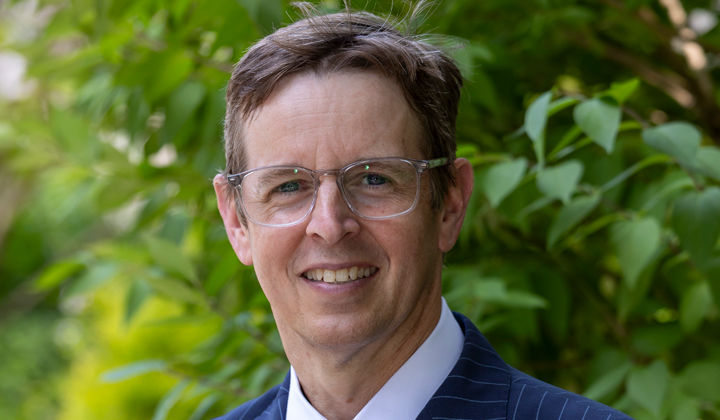
Greg Ridgeway, Rebecca W. Bushnell Professor of Criminology and professor of statistics and data science at the University of Pennsylvania, was recently awarded the Journal of the American Statistical Association’s 2026 reproducibility award for his paper titled “A Conditional Ordinal Stereotype Model to Estimate Police Officers’ Propensity to Escalate Force.” Amstat News wanted to know more about Ridgeway, his approach to research, and what the award means to him. Here is what he had to say:
How do you describe your approach to research and writing?
I do not think I have a particularly intentional approach, but what usually happens is an extended iteration among mathematics, computing, and data analysis. This research built on earlier ideas I had developed for using conditional likelihood to study police use of force. I first needed to solve a mathematical problem: Is there an ordinal model for which nuisance parameters would drop out of a conditional likelihood? Answering that question required a lot of paper-and-pencil work.
Then the question became whether the method was actually computable. Early attempts worked but were slow, so I spent a lot of time figuring out how to improve the computation. That led to better algorithms that drew on recent developments using the discrete Fourier transform.
Finally, I had to determine whether the method actually worked. I tested it with a suite of simulations that explored boundary cases, a small example with three officers, an example in which not all officers interact with one another—creating identifiability challenges—and variations in the number of officers and the number of uses of force per officer. Those simulations were intended to double-check the mathematics, test the algorithms, and provide a reality check about whether the method could work on real data.
Only after that did I run the analysis on the real dataset with some confidence that the mathematics, computation, and simulation evidence were all pointing in the same direction. I worry a great deal about mathematical errors and programming bugs, so a lot of my process involves checking repeatedly whether the math and algorithms are correct.
Was there a particular challenge or turning point in your work that shaped how you think about reproducibility in research?
Yes. Soon after I received my PhD, I published a report on gang and gun violence in East Los Angeles. A colleague later had additional questions about the research, so I revisited my analysis and realized that all of the results labeled as gun violence were actually the results for gang violence and the results labeled as gang violence were actually the results for gun violence. I had switched the labels. With a little more effort, I could have written test code to check the final tables I had produced.
From then on, I made a point of posting code and data whenever possible. Making everything publicly accessible is one of the most transparent forms of quality control. Maybe no one will ever check, but at least it is possible for someone to review the work, ask probing questions, identify problems, and offer improvements.
In the article associated with this award, I developed a statistical model that I think every police department should be using to review officers’ patterns of force. Departments, along with the research communities that support management and oversight efforts, need to have confidence that the methodology is legitimate. Access to the methodology, and the ability to test it independently, is important if the method is ever going to be adopted.
I was also fortunate to collaborate with the Seattle Police Department, which has one of the strongest research infrastructures among police departments and has been unusually open with its data. The Seattle data are posted along with the code, so anyone can rerun, scrutinize, or hopefully improve the methodology.
How do you feel about winning the reproducibility award?
I was surprised, mostly because I did not feel I had gone above and beyond what should be expected. I posted the data, code, and methodology on GitHub, which I think should be standard practice.
Mostly, I hope the award draws more attention to what statisticians have to offer public safety research. There are many open research questions, many untapped data sources waiting to be explored, and a great deal of room for improving public safety in our communities.
Over the course of his career, Ridgeway’s statistical methods have been implemented in police departments, including Cincinnati, Los Angeles, and New York City, as well as in federal public defender organizations and drug treatment program evaluations.
Ridgeway is a Fellow of the American Statistical Association and has been recognized across multiple scientific communities for his contributions to statistical methodology and applied criminology.
The award highlights Ridgeway’s commitment to developing rigorous, reproducible methods that improve real-world decision-making systems.
The award will be presented to Ridgeway during the Computing and Graphics Joint Section meeting at the Joint Statistical Meetings in Boston.
Leave a Reply