
Benmei Liu, WSS President
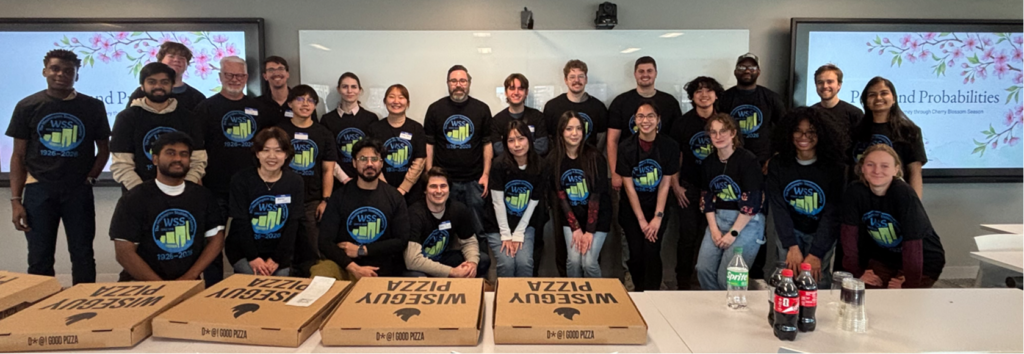
Students, the invited speaker, and several WSS board members wear WSS 100th anniversary commemorative T-shirts at the Petals and Probabilities Cherry Blossom Forecast Hackathon.
The 2025–2026 service year (July 1, 2025–June 30, 2026) marked a defining chapter in the history of the Washington Statistical Society. As the society celebrated its 100th anniversary, it reflected on a century of contributions to the statistical profession while launching new initiatives to strengthen member engagement, expand partnerships, and prepare for the future. Despite significant challenges in the first half of the year, members and volunteers demonstrated resilience and dedication in the second half, making it one of the society’s most active and successful years in recent memory.
During the fall of 2025, external factors affecting member availability and event planning significantly disrupted WSS activities. As a result, the Morris Hansen Lecture and Roger Herriot Award Lecture were postponed until spring 2026 and the traditional WSS holiday party was canceled. Despite these challenges, WSS resumed a full slate of activities beginning in January.
The society’s centennial celebration began on January 20 at NORC in Washington, DC, where more than 75 attendees—including past WSS presidents, current members, the ASA president, and the ASA executive director—gathered to celebrate the society’s history and impact. As part of the centennial initiative, WSS also updated its history book to document the society’s first 100 years through June 30 of this year.
WSS continued to expand its programming throughout the spring. In February, the society hosted its first student representative–led event, the Petals and Probabilities Cherry Blossom Forecast Hackathon at Georgetown University Capitol Campus, bringing together students to apply statistical modeling to predict Washington’s peak bloom date. The postponed 33rd Annual Morris Hansen Lecture was successfully held in March at Summit Consulting in Washington, DC, attracting more than 100 attendees for a presentation by Partha Lahiri and discussions by Rebecca Steorts and Lisa Mirel. In June, the President’s Invited Talk and Annual Awards Ceremony was held at Westat in Bethesda, Maryland, drawing more than 65 attendees. The event featured a keynote by Travis Hoppe about artificial intelligence and the future of evidence, followed by a fireside chat with Liz Mannshardt. The ceremony also recognized recipients of the society’s major awards, expanded the president’s award to honor three centennial cohorts, and celebrated nine WSS members elected as 2026 ASA Fellows.
Virtual programming remained a cornerstone of WSS activities. The society hosted the Roger Herriot Award Seminar, the Gertrude M. Cox Award Lecture, and a webinar by Jae-Kwang Kim about calibration estimation, together engaging hundreds of participants. WSS also collaborated with RTI International on a webinar series exploring emerging topics in survey research. The inaugural virtual panel, Small Area Estimation and the Future of Survey Research, attracted more than 165 attendees. Additional panels on artificial intelligence and other emerging topics are planned.

Outgoing WSS President Benmei Liu, incoming WSS President Lisa Mirel, and several award recipients at the June 17 WSS Annual Award Ceremony. From left: Lloyd Hicks, Lisa Mirel, Ujjayini Das, Wesley C. DeMontigny, Ethan Chen, Patrick Roney, Benmei Liu, Glenn White, Rishik Shenolikar, and Callie Deng.
Beyond programming, WSS strengthened its organizational foundation by filling several previously vacant volunteer positions, including student representatives, reviving the newsletter’s employment column as Job Seeker’s Ally, and conducting its annual officer elections through a competitive slate process.
The society also expanded its collaborations across the statistical community. WSS continued its partnership with DC-AAPOR in planning the annual DC-AAPOR/WSS Review Preview Conference scheduled for September 9, sponsored several professional meetings and educational activities, initiated a collaboration with the International Association of Survey Statisticians to develop future short courses, and strengthened partnerships supporting jointly sponsored awards such as the Julius Shiskin Award and Roger Herriot Award.
As part of its centennial celebrations, WSS also partnered with several ASA sections to host a joint mixer at the 2026 Joint Statistical Meetings in Boston, marking the society’s first networking mixer at JSM. In addition, WSS organized a topic-contributed session, A Century of Washington Statistics, featuring five past WSS presidents who reflected on the society’s history, accomplishments, and future.
As a chapter of the American Statistical Association, the quarterly meetings of ASA chapter presidents have provided valuable opportunities to exchange ideas, learn from other chapters, and strengthen local statistical communities.
Looking ahead, WSS continues to face challenges, including securing stable venues for in-person events, obtaining financial sponsorship, and recruiting volunteers. As we begin our second century, our priorities include growing membership, increasing engagement among students and early-career statisticians, strengthening partnerships, and embracing the opportunities and challenges that artificial intelligence presents for our profession.
Leave a Reply