
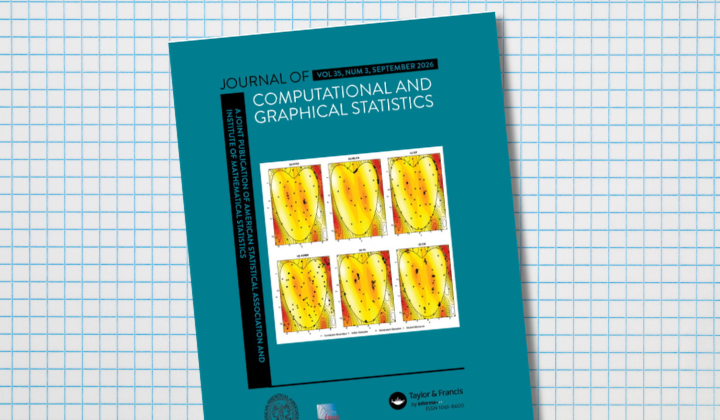
The Journal of Computational and Graphical Statistics presents the very latest techniques on improving and extending the use of computational and graphical methods in statistics and data analysis.
Established in 1992, this journal contains cutting-edge research, data, surveys, and more on numerical graphical displays, methods, and perception. It’s written for readers who have a strong background in statistics but are not necessarily experts in computing. It is published in March, June, September, and December.
The latest issue—volume 35, issue 3—contains 40 research articles, spanning statistical learning, Bayesian computation, networks, functional and spatial data, streaming data, clinical-trial design, and high-dimensional inference.
Statistics for Data in Motion
Modern statistics is becoming faster, more adaptive, more interconnected, and increasingly comfortable with complexity. A central theme is learning from data that changes over time. The latest issue introduces methods for streaming high-dimensional data, online spectral estimation, time-varying seasonal patterns, and clustering locally stationary time series. Other work tracks structural changes in evolving networks and develops models for spatiotemporal phenomena such as extreme US wildfires and fine-grained travel patterns in cities. Together, these studies illustrate a shift from statistical analysis conducted on fixed datasets toward methods capable of learning continuously as new information becomes available.
The issue also reflects the continuing rise of high-dimensional and machine-learning methods. Researchers tackle prediction with neural networks, support-vector machines, regression clustering, factor analysis, and dimension reduction—including methods designed for data whose observations are functions, matrices, metric-space objects, or probability distributions. Rather than treating these unusual data structures as obstacles, the papers build statistical tools around their geometry.
Bayesian computation is another major thread. New approaches make Bayesian inference faster for functional data, latent Gaussian models, hierarchical models, Hawkes point processes, and log-concave densities. Several papers focus explicitly on computational efficiency, reflecting a practical reality: A statistically elegant model is useful only if researchers can actually fit it to modern datasets.
Networks receive equally sophisticated treatment. The issue develops approaches to community detection, Bayesian network modeling, multivariate independence testing, and privacy-preserving analysis of covariate-assisted networks. These contributions recognize that relationships between observations can be as important as the observations themselves—and that protecting those relationships can be essential.
The applications are broad. Methods address personalized clinical trial design, wildfire risk, ridesharing, spatial point processes, and functional data classification. Transfer learning, distributed regression, missing-data methods, and robust estimation extend statistical analysis to settings in which information is incomplete, dispersed, contaminated, or drawn from related but unequal populations.
Collectively, the 40 papers of this issue bridge complex theoretical rigor with immediate practical utility, offering computational statisticians an indispensable roadmap for addressing the next generation of data-intensive challenges. It points toward a future in which statistics is not a static toolkit but an adaptive discipline for increasingly dynamic and structurally complex data environments.
Modern statistical methodology must accommodate evolving information, exploit structure across diverse data sources, quantify uncertainty, preserve privacy, and operate within realistic computational constraints.
Visit the ASA Member Hub for details about how to access the Journal of Computational and Graphical Statistics and other ASA journals.
Leave a Reply