
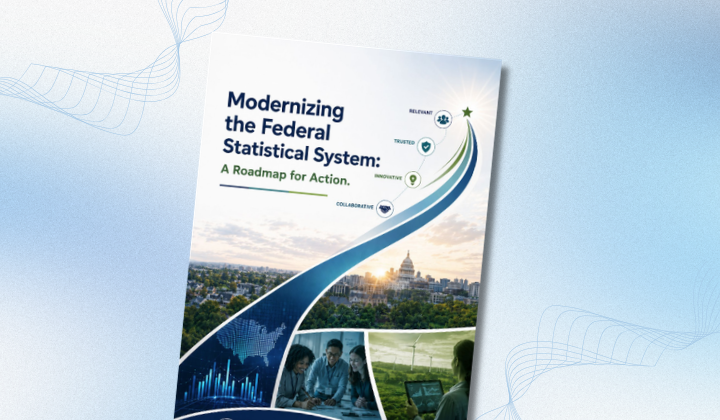
William Beach, Erica Groshen, Nancy Potok, Rochelle (Shelly) Martinez, Jennifer Park, and Steve Pierson with Constance Citro, independent consultant and senior scholar and former director, Committee on National Statistics.
The nation’s federal statistical system is facing a crisis. Longstanding challenges—including declining survey response, aging infrastructure, constrained budgets, and difficulty taking advantage of new data sources—have been compounded by major disruptions. The ASA’s Federal Statistics Health reports (2024, 2025, 2026) document the nature and magnitude of this decline: substantially fewer staff, declining purchasing power, and significant leadership gaps across the statistical agencies.
A Loss by the Numbers
Every one of the 13 principal statistical agencies has experienced staffing reductions. Six have lost at least one-third of their workforce, and only six had permanent, non-acting leaders as of July 1. Although most agencies have continued to deliver their core products, many products have been reduced, are less granular, or are delayed, as is documented by the ASA Federal Statistics Health Project and DataIndex.us. The result: Less federal statistical data is now available to inform the public.
Bold Action Needed Now
Federal statistics inform decisions by Congress; federal, state, and local governments; businesses; researchers; financial markets; and households. The system’s future capacity will depend heavily on staffing, funding, leadership, and policy decisions—and will require strong action by both Congress and the administration.
A Path Forward
Against this backdrop, we initiated Modernizing the Federal Statistical System: A Roadmap for Action. With the support of the American Statistical Association, we held candid conversations about the need and appetite for system-wide change with former agency leaders, current and former chief statisticians, experts from academia and industry, federal statistical agencies, and other stakeholders. The year-long process revealed broad agreement on a vision for a statistical system that is more relevant, timely, granular, secure, and trusted. These conversations informed our framing of the roadmap.
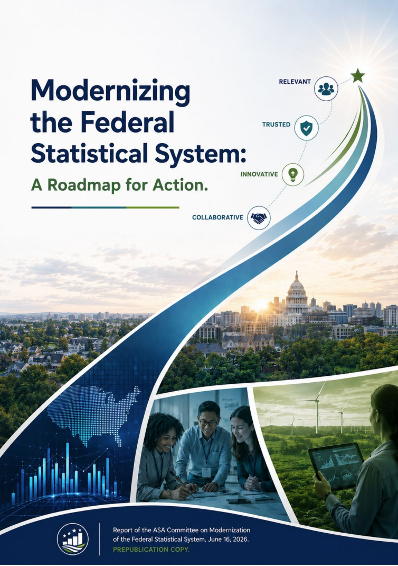
30 Actions for a More Adaptive and Resilient System
The roadmap recommends 30 actions toward a more adaptive and resilient federal statistical system—one capable of producing statistics that are faster, more granular, and more responsive to emerging needs while protecting privacy and maintaining public trust.
The roadmap does not start from scratch. Several of its recommendations would complete actions envisioned under the bipartisan Foundations for Evidence-Based Policymaking Act, particularly those involving secure access to administrative data and data sharing. Others would strengthen or connect to work already underway, including the National Secure Data Service, privacy-enhancing technologies, AI-ready data, public-private research partnerships, and shared infrastructure.
Executive and legislative leadership are both essential. The executive branch should launch and coordinate modernization; strengthen the capacity of the chief statistician and Interagency Council on Statistical Policy; complete the pending Evidence Act implementation; remove administrative barriers; and advance shared infrastructure, strategic planning, and innovation.
Congress has complementary responsibilities. The roadmap calls for sustained congressional oversight and Government Accountability Office assessment of modernization progress. Congress can also address statutory barriers to data sharing, strengthen confidentiality protections, provide multiyear funding flexibility, support major cross-agency investments, and establish and fund a federal statistical system innovation fund.
Neither branch can succeed alone. Executive action without congressional engagement will encounter legal and resource constraints; legislation and funding without coordinated implementation will not produce an integrated statistical system.
The ASA Community in Action
Modernization requires engaging our community. Stakeholders, reacting to the roadmap’s release, identified dedicated funding and budget flexibility, clear executive direction, partnerships, and access to tools and infrastructure as particularly important near-term priorities. They committed to actions ranging from briefing policymakers and convening professional organizations to supporting agency innovation, engaging states, developing policy analyses, and building bipartisan constituencies for federal statistics.
That engagement was visible at the JSM 2026 invited panel, “Meeting the Moment: Communities in Action to Advance Federal Statistics.” The session brought together representatives of initiatives responding to recent disruptions in federal statistics ranging from monitoring changes in data quality and accessibility, reenvisioning diminished statistical agencies, engaging public-private partnerships to develop alternative data and aligned standards, developing additional statistical indicators, and preserving data products at risk of loss. Demonstrating the breadth of engagement, the panel included participants from federal agencies, academia, nonprofits, philanthropy, and the statistical community.
How to Get Involved
The crisis facing federal statistics has deepened but so has the determination to act. The roadmap provides a common framework for turning that energy into sustained modernization. The next step is connecting these efforts with the executive branch, Congress, statistical agencies, professional organizations, academia, philanthropy, the private sector, states, and data users—each engaging in the modernization agenda they are best positioned to advance. Every member of our community has a role. Learn more about this project.
The Roadmap’s 30 Recommendations
- FSS Modernization Task Force
- Congressional oversight
- TIP-NSDS innovation partnership
- NAIRR-NSDS PET development
- DOIs for statistical products
- AI-ready statistical data
- Remove innovation barriers
- Private-sector data feeds
- Legal review for data partnerships
- State administrative data access
- Implement presumption of access rule
- Finalize data-sharing regulations
- Remove data-sharing barriers
- Strengthen confidentiality penalties
- Reduce respondent burden
- Protect statistical objectivity
- External data product review
- Assess data user demand
- Private-sector standards collaboration
- Update statistical policy directives
- Shared IT infrastructure
- Coordinate FSS budget planning
- Streamline IT governance
- Unified strategic planning
- Multiyear funding flexibility
- PFEI and major interdependency funding
- Create FSS innovation fund
- Fund FSS innovation initiatives
- FSS brand and product identity
- Gold-standard statistical designation

William Beach

Erica L. Groshen

Nancy Potok

Rochelle Martinez

Jennifer Park

Steve Pierson

Leave a Reply