
Siddesh Kulkarni, Kelly H. Zou, Benjamin Leiward, Marcia Levenstein, and Dhaval Patel
The Second AI Workshop New York City, under the theme “Artificial Intelligence and Statistics Intersect,” brought together a diverse and intergenerational community of scientists, engineers, clinicians, technologists, students, and industry leaders. It was a full‑day exploration of artificial intelligence and its rapidly expanding role in healthcare, biopharma, and society.
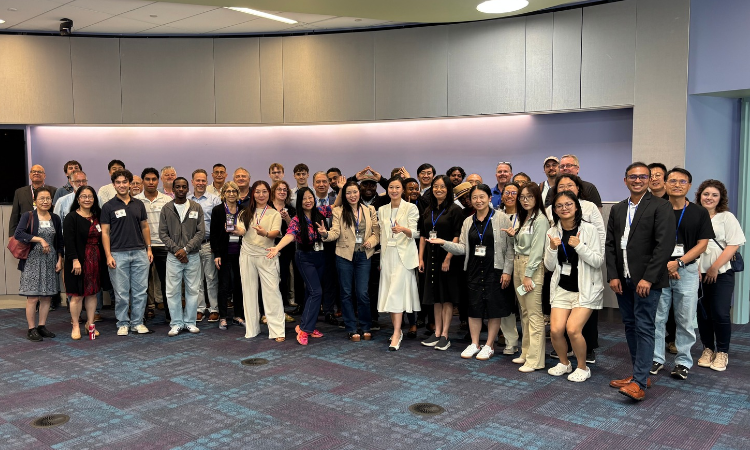
The AI workshop—an Anthropic Claude event held in Tarrytown, New York, on July 26—served as both a technical deep dive and a community‑building forum, emphasizing responsible innovation, statistical rigor, and the importance of cross‑sector collaboration. More than 100 participants arrived from as far as Italy, reflecting the growing momentum behind AI education and workforce development.
The workshop was preceded by informal meet‑ups in NYC, hosted by the ASA NYC Chapter and AI4Purpose, both nonprofit organizations, alongside partners. These gatherings set the tone for the workshop’s emphasis on accessibility, mentorship, and inclusion. Attendees ranged from college students beginning their statistical and data science journeys to senior executives shaping enterprise‑scale AI strategy. This broad participation reinforced the workshop’s mission: to democratize AI knowledge, cultivate responsible leadership, and strengthen the ecosystem for ethical AI development.
At the heart of the workshop was the recognition that AI and statistical science are deeply intertwined. While generative and agentic AI have captured public imagination, the workshop underscored that trustworthy AI requires rigorous statistical foundations, transparent methodology, and careful evaluation. Sessions highlighted how real‑world data, biostatistics, and machine learning converge to support clinical decision‑making, drug development, and public health insights. Speakers emphasized that AI is not a replacement for scientific judgment but a powerful extension of it, one that must be deployed with accountability and respect for societal impact.
Throughout the day, the morning program opened with keynote talks that framed the current landscape of AI innovation. Presenters discussed the evolution of generative models; the emergence of agentic systems capable of autonomous task execution; and the growing importance of multimodal architectures that integrate text, images, biological sequences, and structured data. These talks provided a shared vocabulary for participants, ensuring that newcomers and experts alike could engage meaningfully throughout the day.
A central theme was responsible AI. Speakers addressed fairness, transparency, reproducibility, and the need for governance frameworks that balance innovation with safety. Discussions explored how bias can enter AI systems through data, modeling choices, or deployment environments and how statistical methods can help detect, quantify, and mitigate these risks. Participants examined case studies from healthcare, finance, AdTech, DigiTech, FemTech, MedTech, etc., illustrating how ethical considerations differ across domains but share common principles.
A parallel track allowed attendees to choose among multiple demonstrations tailored to their interests. One track focused on technical foundations, offering hands‑on demonstrations of machine learning pipelines, model evaluation techniques, and generative AI workflows. Participants experimented with prompt engineering, fine‑tuning, and agent orchestration, gaining practical experience with tools used in industry. Another track emphasized clinical and biomedical applications, exploring how AI supports diagnostics, prognostics, real‑world evidence generation, and regulatory‑grade analytics. Clinicians and data scientists discussed the challenges of integrating AI into clinical workflows, including data quality, interpretability, and patient trust.
Additionally, panelists examined how AI is reshaping labor markets, education, and public health infrastructure. They discussed the importance of interdisciplinary collaboration, noting that statisticians, ethicists, engineers, and policymakers must work together to ensure AI systems serve the public good. Participants debated emerging regulatory frameworks, including transparency requirements, model documentation standards, and the role of professional societies in responsible AI practice.
Throughout the day, the workshop emphasized mentorship and community building. A structured mentor‑matching session connected students and early‑career professionals with experienced leaders in biopharma, academia, and technology. Mentors shared career advice, insights into AI‑driven roles, and guidance on navigating interdisciplinary environments. This session was particularly impactful for younger attendees, many of whom were exploring AI for the first time. The workshop’s intergenerational design ensured that learning flowed in both directions: seasoned professionals gained fresh perspectives from students, while students benefited from real‑world experience and strategic insight.
The afternoon featured a mini‑hackathon, during which participants collaborated on short, focused challenges. Teams worked on tasks such as building simple predictive models, designing responsible AI workflows, or developing creative generative AI applications. The hackathon encouraged experimentation, teamwork, and rapid prototyping. Importantly, it also reinforced the workshop’s message that AI is not merely a technical discipline but a collaborative one—requiring communication, creativity, and shared problem‑solving.
A roundtable discussion brought together statisticians, AI researchers, clinicians, and industry executives. The conversation explored how statistical rigor underpins trustworthy AI, how real‑world data informs model development, and how organizations can build AI capabilities that integrate scientific integrity with operational impact. Participants discussed the need for continuous learning, noting that AI evolves quickly and requires ongoing education for both technical and nontechnical stakeholders. The roundtable also addressed the importance of diversity in AI development by emphasizing that teams produce robust and equitable systems.
The closing session reflected on the workshop’s achievements and outlined next steps for the community. Organizers emphasized the importance of sustained collaboration, encouraging participants to continue engaging through meet‑ups, mentorship networks, and future workshops. They highlighted opportunities for students to pursue internships, research projects, and leadership roles in AI‑related fields. For industry professionals, the workshop reinforced the need to integrate responsible AI principles into organizational strategy, governance, and culture.
Editor’s Note: The views in this article are those of the authors and do not necessarily reflect those of their respective organizations.
Leave a Reply