
Real World Data Science, a publication of the Royal Statistical Society in partnership with the ASA, serves people working in data science who are looking for practical insights, methodological rigor, and thought leadership that informs their work and decision-making.
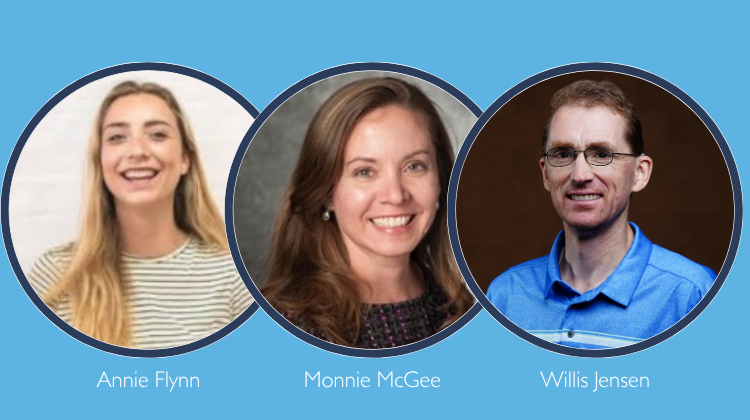
In the March 2026 episode of the Practical Significance podcast, cohosts Donna LaLonde and Ron Wasserstein welcomed managing editor Annie Flynn (Royal Statistical Society) and editorial board members Monnie McGee (Southern Methodist University) and Willis Jensen (CHG Healthcare) to talk about what stories need to be told.
Donna LaLonde: Tell us about your day jobs.
Monnie McGee: At Southern Methodist University in Dallas, Texas, I’m an associate professor of statistics and data science. I also chair the ASA Committee on Publications.
Willis Jensen: My day job is leading a business intelligence and analytics team at CHG Healthcare, and I’m also an adjunct professor of statistics at Brigham Young University.
Annie Flynn: I’m the head of content at the Royal Statistical Society, which is basically the UK equivalent of the ASA. And a big part of this is serving as managing editor of Real World Data Science.
Ron Wasserstein: Annie, what inspired the creation of Real World Data Science, and how has it evolved since it launched?
Annie Flynn: Real World Data Science was created by my predecessor, Brian Tarran, who’s a great writer and editor in this statistical space. He wanted to fill a gap he felt existed between theory and practice.
There’s a huge amount of excellent material out there on statistical methodology, but far less that shows what happens when those methods meet real data, real constraints, and real decision-making environments.
The RSS wanted to create a space that focused specifically on applied data science, how it gets done in practice, what challenges arise, and what lessons people learn along the way. All that sort of thing.
But then, we also wanted to provide the opportunity for practitioners in the field to respond more in real time to new developments and new ideas. And since launch, it’s evolved in a few important ways.
The scope has narrowed a little bit. At first, the focus on accessibility led us to create a significant amount of content for students and early-career scientists. Since then, we’ve realized that this content is already covered well elsewhere, and what the world really needs are high-quality tutorials and case studies on cutting-edge methods relevant to established practicing data scientists.
Obviously, we still want our content to be inclusive and accessible, but our focus is now a bit more squarely on that established practitioner.
Ron Wasserstein: Monnie and Willis, what makes Real World Data Science different from other data science resources that are available?
Monnie McGee: One of the first articles we published was called “Keeping the Science in Data Science,” so talking about using science to drive the data analysis rather than the other way around. And of course, we want things that are statistically sound, but we also want them to be context-driven to ensure we’re answering the question that was posed.
I believe ethics is also an important feature—the fact that ethical data science is good data science. And that’s something I would love to see more features on, as well.
Willis Jensen: There’s so much content out there, and generative AI is only making it harder to find good content. We strive to provide higher-quality content that’s vetted and curated by experts.
You can trust the content because you know it’s been reviewed by real data scientists—people doing this work in industry and practice. So, I believe the quality of the content is going to be so much higher than anything else you can find out there.
Donna LaLonde: What types of submissions make you stop and say, “We need to publish this?”
Monnie McGee: I like the idea of the honest-failure submission—the ones where research didn’t go according to plan. I’d like to publish pieces that talk about the road there. An example from an author: “We tried this state-of-the-art LLM, and it failed miserably because of X. We used these statistical methods to show this is why it failed, and we had to make this shift to fix it.”
Most people don’t want to talk about their mistakes, but these are well suited for Real World Data Science.
Willis Jensen: We’re looking for examples and case studies. Did the article answer a question? Did it make an impact on the decision? What was the impact?
Something that solves a problem or answers an important question—that’s what makes me stop and say, “We need to publish this.” Those articles are practical, real-world, and have an impact you can quantify.
Ron Wasserstein: Annie, in your role as managing editor, how do you balance the distinction between technical depth with accessibility for readers at different skill levels?
Annie Flynn: We want our content to be as accessible as possible in terms of how it’s written, but not necessarily introductory in its technical level. Clear language, well-explained context, and good structure—these are areas where we can help authors. We focus on material that gives practitioners something they’re less likely to find in standard learning resources.
We always encourage authors to make their reasoning explicit and to define their assumptions and explain their decisions without stripping away technical substance.
If an author has a great piece of work or a great method they want to explicate, we can help with the writing side of things. We also work quite closely with contributors during editing to improve clarity and flow and ensure technically rich pieces are still readable and engaging.
Donna LaLonde: Monnie, with ASA members in mind, what emerging areas would you like to see addressed?
Monnie McGee: I would really love to see a classroom-ready, end-to-end case study. Articles on communication and collaboration skills too. We have narratives that tell compelling stories about projects, but educators need more than the story—they need tools for bringing it into the classroom. Perhaps a teacher’s kit.
I’d like to see articles about sports: how people acquire and analyze sports data and find real-world applications for it.
And more about ethics and the use of generative AI. When is it appropriate, and when is it not appropriate? How can you use it ethically and intelligently?
Donna LaLonde: Willis, what should your industry colleagues in the ASA be writing about?
Willis Jensen: As an industry practitioner, I’ve noticed it can be difficult to publish in traditional journals because they often prioritize novelty over more routine applications of regression, machine learning, or neural networks. We would welcome such contributions.
The emphasis is not necessarily on the novelty of the method, but on the novelty of its application or the significance of its impact.
Ron Wasserstein: Annie, walk us through the typical submission and editorial process for a potential contributor.
Annie Flynn: We’ve tried to design a process that’s supportive, transparent, and familiar for people accustomed to technical workflows, but we support a range of different formats.
You can submit to us with a Word document or any normal text file, whatever you like to use. But we also support code-rich and reproducible documents. You could use tools such as Quarto, RStudio, or VS Code to work locally, then submit HTML drafts and QMD files.
I recommend you start by getting in touch with an idea. We’ll then work with you to shape it into a content brief, thinking about the audience, key messages, and scope.
We want to help set you up to succeed before you produce your first draft.
And then, the editorial review phase is more transparent and collaborative than people might be used to if they’ve already submitted to academic journals or other sorts of platforms. We provide clear feedback from the board and work with you to refine the article.
Obviously, we’re intent on being as rigorous as we can and making the piece the best it can be, but it’s also very collaborative. And you’ll always get to preview the final version before it goes live to ensure you’re happy with it. Then, we’ll always support you with promotion and sharing.
Ron Wasserstein: How would I go about citing the article? What are you doing to make that work discoverable?
Annie Flynn: Every article closes with a linked citation, and we promote all the articles across different social channels. And we also encourage authors to share their articles on their platforms and networks. We’ll support you in any way we can.
Willis Jensen: An academic or traditional ASA perspective typically looks down on website citations because they’re not to the same standard as a journal article. However, this is changing with many quality publication venues beyond the traditional journal. Because of the curation and review process that we have with Real World Data Science, ours is a valid, high-quality citation. The articles have been vetted and undergone a rigorous review process.
Donna LaLonde: What advice would you give to an experienced data scientist who’s never published before?
Willis Jensen: Put aside everything you know about the traditional publishing process. Our process is not an adversarial referee-writer relationship. It’s very much a partnership.
If you have an idea that’s not fleshed out, just share it with us, and we can work with you and help you develop something that would be really valuable.
Monnie McGee: Agreed. You don’t need to submit a polished article. You can submit an idea or an outline. You can just brainstorm something you want to do and submit that. Just go for it, and get in touch.
Ron Wasserstein: What is your hope for Real World Data Science over the next few years?
Annie Flynn: Going forward, I would like to focus on the community side of it. I would love for some of the pieces to build connections between practitioners, researchers, and even decision-makers in the spaces the content references. To start conversations that provoke ongoing discussion. Data quality has become a hot topic for us. And that’s where we can have real impact.
Monnie McGee: One of my visions for Real World Data Science is that it will be a place where people can go to find work they can trust because they know experts have evaluated the content and worked with the authors to make it accessible and technically appropriate.
Willis Jensen: As statisticians, we perhaps see data science as a separate field. Over time, I hope to see more merging or synergy within the discipline. And the ASA’s partnership with the RSS in supporting Real World Data Science is just another step toward that synergy.
Editor’s Note: At the time of recording, Willis Jensen worked for CHG Healthcare. He is now an associate professor at Brigham Young University.
Leave a Reply