
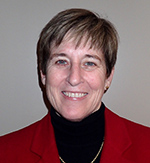
Coleman Harris
Linda J. Young, who grew up in the small town of White Deer, Texas, enjoyed math from an early age. Before her senior year in high school, she applied for a National Science Foundation program on probability and FORTRAN programming at the University of Tennessee-Knoxville. After thoroughly enjoying her experience with statistics and computer science, she ended up at West Texas State University (now West Texas A&M University) to pursue her bachelor’s and master’s degrees in mathematics.
Hailing from an academic family, Young planned to earn a PhD in mathematics at Oklahoma State University but found herself inclined toward the statistics department. This introduced her to a formative project in her career: Why were all the golden marmosets at the Oklahoma City Zoo getting sick? After going behind the scenes and learning the right questions to ask, she was hooked. She then traversed Oklahoma’s scorching hot cotton fields to develop sequential sampling plans for cotton pests, culminating in her doctoral thesis work.
Young spent a few more years working with the faculty at Oklahoma State after finishing her PhD, collaborating with entomologists and weed scientists. Sensing it was time to leave the university, she took a position working at the University of Nebraska, collaborating again with those in the agricultural sciences. She says a key to her consulting success was personally observing occasional experiments—there was always a gap between what she thought researchers meant and what they were actually saying. From zoo cages in Oklahoma City to sloped fields in Nebraska, this helped her fully understand the challenges of applied agricultural research.
Realizing again that she needed a change, Young recalls a memorable email from renowned statistician George Casella, then a faculty member at the University of Florida. He wrote, “Linda, I heard you might be interested in changing your snow shoes for sunglasses.” She left for Florida, also excited to trade agricultural problems for new problems related to the effects of red tide and issues for wildlife like manatees and sea turtles. Subsequently, she formed new collaborations with the Florida Department of Health, looking at the impact of climate change and heat on the health of Floridians.
Young began spending summers in Washington, DC, after being recruited by the National Institute of Statistical Science (NISS) to work on a problem for the USDA’s National Agricultural Statistics Service (NASS). Her team comprised methodology to improve annual estimates of farm counts as a supplement to the Census of Agriculture, measured every five years. Pulling on her experiences in ecology, she hoped to implement designs similar to capture-recapture methodology to improve the severe underestimates NASS measured.
Young eventually moved to NASS full time, taking on the chief mathematical statistician and director of research and development positions. There, she has focused on making a national impact using statistics, namely implementing the capture-recapture methods into the Census of Agriculture in 2012 and an enhanced methodology in 2017.
The future, she says, is all about incorporating other kinds of data to make the census estimates more accurate. At present, she is working on a method using web scraping to supplement traditional estimates and aims to incorporate more administrative data into the next decade. And even though she moved to NASS to implement capture-recapture, she is excited about the future including learning and implementing new types of data. It requires the learning and growing process she says is necessary to succeed as a statistician—the continual evolution her PhD prepared her for nearly three decades ago.
Linda Young on Consulting
Would you consider yourself a statistical consultant? If not, what would you call yourself?
I think of myself more as an applied researcher. I have done consulting projects throughout my career, but, in the end, some solutions require innovation. And so, there’s usually a gap between the material that’s first published in journals and what can be done in practice—that interface between the science and the statistics is where I basically live. So, I’ve done consulting where I didn’t need to do anything new, but often it’s an applied problem that requires research and innovation to actually address the issues at hand.
How does a statistical consultant role change between academia and government?
The emphasis is different in the two places. At a university, the emphasis is on publication, and in the government, it’s on the product you put out. You can’t always implement the optimal solution in the government, because there’s a strict timeline you have to adhere to; if you have a Bayesian model that takes a week to run, it’s not suitable. At the university, the secondary goal is the project answer, getting something that addresses the real-world problem; if they don’t quite solve the problem, they can still publish. So, you have those kinds of trade-offs. And it requires a real understanding of the gives and takes and what’s important—what you really mean with your set of assumptions. Then, you have to consider what method would be robust enough to implement, even if it’s not the optimal solution.
What advice would you give someone who wants to have a career as a statistical consultant?
Think about what you’d like other than statistics, because you cannot be an effective statistical consultant without learning about the subject matter. I could not do what I’m doing at NASS if I had not been involved with farming. So, I won’t be making a mistake simply because I don’t know winter wheat is planted in the fall and harvested the next year. You have to like not just the statistics, but you have to like what you’re applying it to and enjoy learning about that subject matter.
Are there any experiences you’d recommend to students interested in statistical consulting, like particular jobs, internships, courses, etc.?
The big thing is to figure out what it is you really like. I learned a lot working in the entomology department for two or three summers, going out to the cotton fields and breeding the plants, and also the experience I had with the Oklahoma City Zoo. And you can do internships, because not everyone wants to do consulting in agriculture, and you could work under a consultant. But the big question is, do you really have fun looking at those kinds of problems?
What makes a good statistical consultant?
The more you can solve problems, the better you get, which is where I was really fortunate. I worked for a professor in the entomology department, and he would ask me tough questions I had to think about. Then, after I came back with the answer, he would have another tough question, and so on. And after a while, I could think about it while I sat there, but that didn’t come automatically for me. It’s important to understand that when you start out, you may not be able to answer the question immediately. There’s nothing wrong with saying you need time to think about it; it takes a lot of practice.
What is the most important career advice you have received?
Find what you love, your passion, and pursue it.
Was there anything you had to change in the transition from academia to government?
I’ve had to continue to update and learn more, and to continue to grow as a statistician. But that’s what the PhD prepares you for, right? This continual evolution, so I have continued to evolve. And sometimes, I do miss teaching. If I wanted to, there are opportunities for me to teach in the area. But, in the government, vacations are not restricted to the summer or between semester breaks, so it kind of spoils you after a while. But teaching and interacting with students is something I miss.
If you could change one thing in your career thus far, what would it be?
I really can’t think of anything, because it took all of my right and wrong choices together to get me to the point I am now, and I’m happy with where I am. Some of my biggest failures taught me lessons that were extremely painful, and I would have given anything not to learn them at the moment. But it is through that growth, through those experiences, that I really grew professionally.
Do you have any parting words for our readers?
I really encourage people to consider statistical consulting—research at the interface of science and statistics—because there’s a great need. People are becoming more statistically literate, but there is still quite a gap. And we can really help make data-based decisions far more solid if we do a good job.
Leave a Reply