
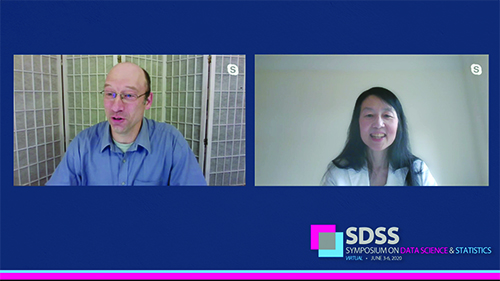
David Hunter, SDSS 2020 Program Chair
SDSS 2020 is in the books! The Symposium on Data Science and Statistics took place from June 3–5, and for reasons everyone knows all too well, it was hardly a typical conference.
In the end—thanks to a lot of hard work by ASA staff members, the program committee, the technical support team from BAV Services, and presenters—the virtual conference ran incredibly smoothly. Compared to SDSS 2019, which attracted nearly 650 attendees, this year’s tally of around 450 was very respectable.
Most notably from my perspective as program chair, the scientific program remained nearly entirely intact. The conference was anchored by three outstanding keynote addresses from Rebecca Nugent of Carnegie Mellon, Jeannette Wing of Columbia, and Rob Tibshirani of Stanford, who spoke about teaching data science, data science for good, and data science in public health, respectively. Obviously, those few words don’t fully capture the nuanced messages delivered by our three expert keynote speakers, and I want to remind everyone that the conference website remains intact. In particular, the online program gives links to abstracts of all the talks along with, in many cases, the slides supplied by the presenters.
We maintained the planned conference format of six parallel sessions, which roughly corresponded to one for each of the six conference tracks: Computational Statistics, Data Visualization, Education, Machine Learning, Practice & Applications, and Software & Data Science Technologies. The sessions were a mixture of invited sessions and refereed contributed sessions, and the latter category was an innovation for SDSS 2020.
The electronic journal Stat has agreed to help produce a special issue consisting of work accepted onto the SDSS program. That journal’s format and editorial policies—quick review time, short articles of no more than 10 pages, and online presence so supporting materials are easy to link—is ideal to support our goal of creating a high-quality, peer-reviewed outlet for conference papers analogous to the many prestigious conference proceedings that have existed in the computing communities for many years. Helen Zhang from the University of Arizona, editor-in-chief of Stat, helped arrange this collaboration.
Moving to the online format forced some creative choices in designing the conference schedule. To cite a few examples, we shifted the start of the scientific program from June 4 to June 3, which allowed us to finish before the weekend. We moved each day’s start and end times to hours of the day that were neither obscenely early for West Coast participants nor uncomfortably late for East Coasters. (Admittedly, many participants from overseas still had to endure some pretty strange conference hours, though we managed to shift a presentation time so the presenter didn’t have to give his talk in the middle of the night local time in at least one case.) Nearly all the planned workshops went ahead, and by moving their time slots from the beginning of the conference to the late afternoon of days one and two, we managed to shorten the overall span of the conference. Our e-poster sessions all continued as planned, with an innovative scheduling idea meant to exploit the flexibility afforded by browsing from your own home: All posters were available throughout the conference on a site with a chat window, and groups of presenters were asked to monitor the chat during certain blocks of time to field any questions from viewers.
There were even some benefits of the online format. For one thing, a great deal of traveling was avoided—along with the concomitant carbon emissions and expense. In addition, quite a few people attended the virtual conference who would not have been able to travel to Pittsburgh to attend in person. I learned this in informal chats during the three social events that featured random shuffling of participants into Zoom breakout rooms for brief conversations. These proved to be really interesting, much like hallway conversations with folks you happen to bump into at an in-person conference. Many people also spoke of the benefit—which admittedly also has a downside—of being able to attend a conference from the comfort of your own home.
The fact that many of the sessions were recorded meant conference participants had the chance to view sessions after they occurred, a facet of the online conference experience sure to please any conference-goer who has ever experienced the frustration of having to choose among multiple interesting talks that happen to be scheduled concurrently. And the ever-present chat window next to the presenter’s video feed allowed participants in an online session to share pertinent comments or links with one another in the middle of a presentation without interrupting the speaker. Indeed, I chatted with more than one participant who said they now realize virtual conferences represent a nuanced set of tradeoffs, with various pros and cons. Some said they imagine the future of scientific conferences might include a hybrid of in-person and online meetings, even when the pandemic is behind us.
Look for announcements about next year’s conference—scheduled for St. Louis, Missouri, from June 2–5—as SDSS continues to innovate to strengthen ties among the statistics, data science, and computing communities.
SDSS 2020 Photos from June 3

SDSS 2020 Photos from June 4

SDSS 2020 Photos from June 5

Leave a Reply