
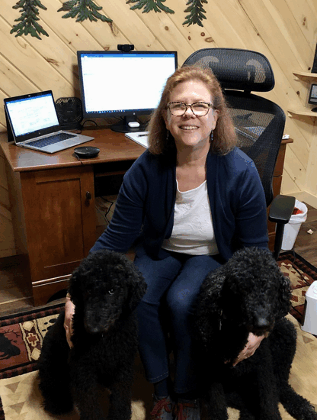
The ASA Committee on Applied Statisticians gives you the experiences of four statisticians who took different paths after their master’s degrees. In previous issues, we featured Kathryn Irvine—who earned a PhD—and Mark Otto—who took a different path and earned his master’s. This month, Allison Florance explains why she found a master’s degree to be right for her.
Allison Florance is global biostatistics development unit head of oncology solid tumors at Novartis and past chair of the Committee on Applied Statisticians. She has an MS in statistics.

I came to statistics through biology. My undergraduate degree is in biology, and I worked in molecular biology labs for five years before going to Iowa State University to earn a master’s in statistics. On-the-job learning—rather than school—was my thing, so I moved to North Carolina and worked with the public health science group at Wake Forest University after graduation to support various NIH grants. The MS-level biostatisticians worked under the PhD professors, who held the grants. I truly loved the work environment, and I was always learning from those around me. But after four years, I had to get out from under the masters-level glass ceiling that exists in much of academia. I did not leave to pursue a PhD, however.
I wanted to work for one of the top innovative pharmaceutical companies, but I couldn’t seem to break into one with my MS and existing experience. I needed more clinical trial experience, which I was able to get at a contract research organization (CRO). I became familiar with the logistics of clinical trials and, after a year and a half, I took a job at GlaxoSmithKline (GSK), where I stayed for 14 years. I was able to work on HIV and oncology in all aspects of drug development. Again, I continued to learn from those around me. When I left GSK, I managed a staff of around 15 PhDs working on early development clinical trials in oncology.
For the last five years, I’ve led a large group of biostatisticians at Novartis. I enjoy supporting and developing my staff while still doing a mix of science and statistics with oversight to strategic drug development. Every applied statistician has a scientific domain to work in, where they have to learn the technical language and working culture. I have found my perfect blend of statistics, science, and development of people in my newest role as global biostatistics development unit head of oncology solid tumors.
Looking back, every organization I worked for would have supported me going back for a PhD. I preferred learning on the job, through continuing education, and sometimes trial by fire. More school just wasn’t for me. Now when hiring for our department, a PhD is required for US positions unless we find an MS with extensive relevant experience. Master’s-level statisticians can still excel and lead in pharma, but it is likely a more difficult road to go down in many of the large pharmaceutical companies than it was for me years ago. Would I change my mind if I were to do it again now? Nope! I chose the right path for me.
Leave a Reply