
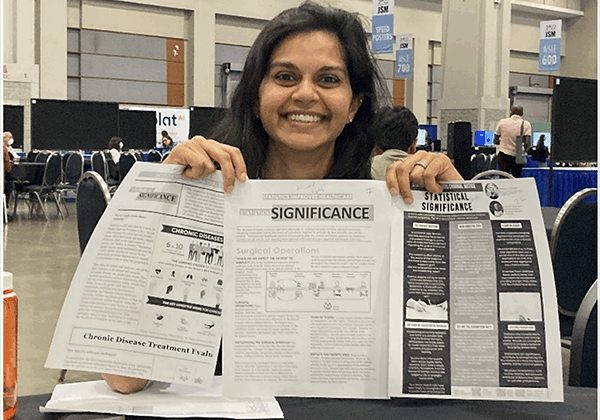
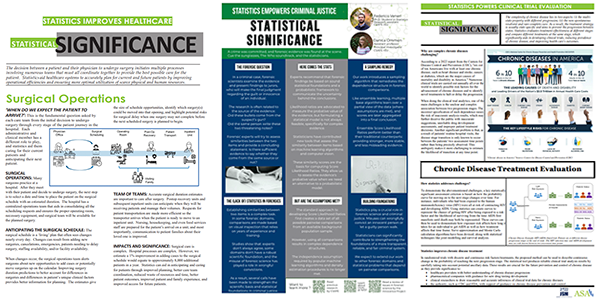
The ASA Scientific and Public Affairs Advisory Committee recently announced the winners of its annual JSM Statistical Significance competition, its first in-person competition since 2019.
The first-place winner and recipient of $300, Eric Hixson of Cleveland Clinic, applied machine-learning techniques to successfully improve the complex task of scheduling surgeries across its large hospital system. In his entry, he estimates “a 1% improvement in adding cases to the surgical schedule would equate to approximately 8,000 additional patients in a year.”
Second-place finisher Xiyuan Gao of the University of Missouri entered her clinical trial work evaluating treatment effectiveness at different stages and comparing treatments at the same stage.
Federico Veneri Guarch of the Center for Statistics and Applications in Forensic Evidence at Iowa State University, also a second-place winner, showed how ensemble score likelihood ratios provide stronger, more stable forensic evidence.
A JSM Statistical Significance entry is a one-page illustration of the value of statistics to society whose objective is to illustrate to a lay person how the statistical solution to the problem presented in the JSM poster would help inform decisions that improve society in specific areas such as health, agriculture, economy, education, manufacturing, and medicine.
Started in 2009, the competition is designed to complement the ASA Statistical Significance documents, a series highlighting the contributions statisticians make to society, from health care and economy to national security and the environment.
Competition Winners
First Place
Eric D. Hixson, Zachary Yachanin, Joseph Dorocak, and Michael Lewis, Cleveland Clinic: A Machine Learning Solution to Predict Surgical Case Duration in a Multi-Hospital Health System
Second Place
Xiyuan Gao and Jianguo J. Sun, University of Missouri, Columbia: Regression Analysis of Doubly Censored Failure Time Data with Ancillary Information
Federico Veneri Guarch and Danica Ommen, Center for Statistics and Applications in Forensic Evidence, Iowa State University: Ensemble of SLR Systems for Forensic Evidence
Honorable Mentions
Eric Gerber and Nelson Guirado, California State University Bakersfield: Competing Risks Analysis of MLB Draft Data
Menglu Liang, Penn State College of Medicine; Zheng Li, Novartis Pharmaceuticals; Liang Li, The University of Texas MD Anderson Cancer Center; Ming Wang, Penn State College of Medicine; and Vernon M. Chinchilli, Penn State College of Medicine: Tackling Dynamic Prediction of Death in Patients with Recurrent Cardiovascular Events
Maisha Maliha, Andrii Zaiats, Payton Lyons, and Trevor Caughlin, Boise State University: Quantifying Post-Wildfire Revegetation Using Satellite Data and Statistical Models: Challenges and Opportunities
Junhui Mi, Cleveland Clinic: The Effect of a Rapid Response Team on the Incidence of In-Hospital Mortality
Leave a Reply