
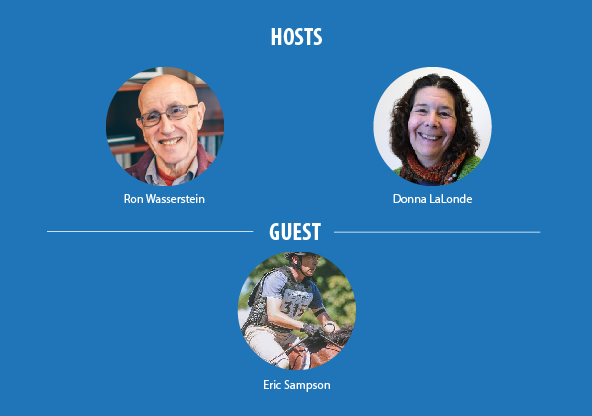

This interview with Eric Sampson, ASA journals manager, was conducted by Practical Significance co-hosts Donna LaLonde and Ron Wasserstein during a recent podcast. If you missed the show, this is your opportunity to read his perspective on the future of publishing. He also offers tips for submitting to an ASA peer-reviewed journal, getting through the review process, and becoming a reviewer or associate editor.
LaLonde: How long have you been the ASA journals manager?
Sampson: I was hired by the ASA to be the journals manager full time in 2008. Prior to that, I was a production editor for the ASA, both in the office and then as a contractor, and that started a long time ago.
Wasserstein: How did you get into publishing?
Sampson: I’ve always loved words, so I’ve always written and been interested in how that gets disseminated. It goes back for me, too, when I was writing and had a paper route and saw how information got to my neighborhood because I took it there and [when I] worked on school newsletters, literary magazines in college, and advocacy newsletters. It’s something that’s been with me for as long as I can recall.
LaLonde: Are you currently doing any writing of your own?
Sampson: The short answer is not much. I do a little bit of writing for [a] local club that I belong to, which is a horse-riding club. But the short answer is not a great deal of writing is happening. That’s one of those things I would like to do much more of.
LaLonde: We, the ASA Publications Committee and colleagues at the publishers, have been having conversations—dusting off our crystal ball—to anticipate what the future holds for the publishing world. Based on your experience and, again, looking into that crystal ball, what changes do you see—ones you’re most looking forward to but, also fair game, those that have you worried?
Sampson: I’m always tempted to say that my crystal ball is in the shop and therefore not easily accessible. But the nature and fundamentals of academic publishing are simply changing. They started somewhat with the move to fully electronic, fully online publishing, although we do sell and send out some physical journals. And now, of course, the question is open access and how do we maintain the quality journals our members depend on and truly expect while providing the access they also are starting to expect, which is, quite frankly, expensive. So how do we support those in a sustainable way, and how do we continue?
Because the journals make up a fraction, but a significant fraction, of the ASA’s revenue. The ASA supports the journals, and the revenue supports other ASA activities. Do we need to develop what is essentially a new funding model to continue producing journals of which I am exceedingly proud?
One of the things I’m proud of about these journals is, for all our journals, there’s no cost to the author to publish with us, so young researchers can get into our biggest titles. Well, all our titles are big, and all our titles are important. It’s a big deal to publish with the ASA. I’d like to keep it that way and keep it affordable for the authors. But how to do that is kind of an open question right now.
Wasserstein: What else do you wish more people knew about ASA journals?
Sampson: Our members hopefully know what a great deal our journals are—they get free online access with their ASA membership, which is one of the most affordable memberships for such an association in the United States. And, here, they can go on and have access to all our ASA titles with a single login. It’s super easy, and I hope they understand and see the value in an ASA membership. I think our journals are not just fundamental to science and fundamental to the association, they’re also one of our most important outreach tools that reach beyond just the statistics profession.
Wasserstein: Roughly how many articles do we publish annually across our suite of journals?
Sampson: Across our suite of journals, we publish about 500 articles a year, roughly, and JASA [Journal of the American Statistical Association] alone accounts for more than 200. That doesn’t include book reviews, letters to the editor, those kinds of things. But easily 500 a year. I started to count pages, but at this point, pages are starting to lose their meaning to many of our users. And remember that those 500 a year ASA journal articles typically have between a 10 percent and 18 percent acceptance rate. So, there are many, many papers constantly in review by our amazing volunteers that simply will not get published in our journals.
Wasserstein: Let’s focus on authors for a moment because you mentioned our journals are very popular, but also difficult to get published in. Authors are looking for guidance as to where to submit their papers and how to get their work out. What advice do you have for authors as they attempt to publish their paper?
Sampson: The first thing is always to look at the aims and scopes of the publications that might be the best suited for your paper. Does your paper fit those aims and scopes? Look at the instructions for the authors. You’ll find a lot of useful information there, much of it from the editors themselves as they refine and try to help the authors understand what it is the editors are looking for. That’s always the first place to start. If you can reach out to an associate editor—if you see a name on the associate editor list you might recognize or whose work you have followed—reach out and ask if your paper might be a good fit for that particular journal.
So many papers are rejected at first submission simply because they don’t belong in the journal. They aren’t looking at the area of research the journal is focused on, or the author simply has thrown the paper into the hopper hoping it gets through. So, it’s super important for everybody to look at the aims and scopes and the instructions for the authors. You will find a lot of good information there to direct your submissions.
LaLonde: How does one seeking to become a reviewer get started?
Sampson: I am really glad you asked. Becoming a reviewer for one of the journals is very easy and just involves creating an account for yourself on the Scholar One manuscript system that the ASA uses for submissions. However, I would say two things about that. First, of course, create the account for yourself because that automatically adds your name to the reviewer list. You can opt out of being a reviewer if you wish, but we would appreciate it if you didn’t. Please stay on because we need your help. When you create your account, be as thorough and precise as possible in filling out your keywords and interests and areas of expertise. That way the associate editors have a better grasp of what papers to send your way for review. When you’re asked to review, I’m going to ask one more favor, and that’s to be prompt.
Be as prompt as you can with your review. We know everybody’s busy. We know this is added work for a volunteer, but you would be amazed at the reviews. One look at just the average review shows such care and real attention to helping these authors make papers better. And if that sounds like you, we would love to have you review once you’ve created your account.
I would encourage you to reach out to an associate editor. You can find those lists online. If you find someone whose name you recognize or even tangentially recognize, reach out and say, “Hey, I want to review papers for JASA. My name is already on the list, here are my areas of expertise. Would love to start seeing some papers.” My guess is you’ll be taken up on that.
LaLonde: Would you share the process of how associate editors and editors are chosen?
Sampson: Associate editors are chosen by the editors and serve at the editor’s pleasure. So, if you start to think these are just the editor’s friends, not really. The editor typically is very familiar with the literature in this area, in the area of focus for whatever journal. And the editors are very keen to add associate editors who are skilled in areas that the editor lacks. So the focus for the editor in creating his or her editorial board is to make sure they have a broad range of areas of expertise that fall within the scope of the journal covered so that when a paper comes in, the editor says, “Oh my gosh, I don’t know much about this topic, but I know this person who I’ve brought on as associate editor knows a lot.” That paper goes to that person.
So again, it’s making yourself known to the editor, but also being active in your areas of research and publishing when you can. And fortunately, we are back to having conferences, so reach out and always let the editors and associate editors know you are interested. And again, you can find those lists online.
For editors, the ASA conducts very thorough, very careful editor searches. And those people tend to come from the associate editor ranks within a given journal. The editors are often chosen because they have already been active in the journal, itself. Clearly, they know the topic, they know the aims and scopes, and they know the focus of the journal. We form search committees and put out the word to get as broad a base of applicants as possible.
We have found that, with several of our journals, the best editors don’t always come from there. And we’ve gotten some amazing editors from even outside the “statistics profession.” They are statisticians, trust us, but they come from other areas. So, it’s a very painstaking process and our search committees have done an amazing job. But to become an editor, that person has typically already been active with the journal and is clearly known in the field.
LaLonde: When members see the announcement for an editor posted, take that seriously because it really is an active search. It’s not a done deal.
Sampson: Oh, it is definitely not a done deal until the ASA Board says it’s a done deal.
Leave a Reply