
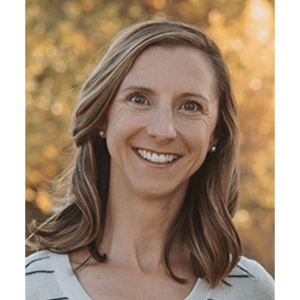
 Institute Data Scientist, GTI Energy
Bailey Fosdick grew up in the small ski town of Steamboat Springs, Colorado, where she skied six days a week for much of her childhood. In her freshman year at the Colorado School of Mines, she loved all her science classes—calculus, physics, chemistry—but she was not a fan of the lab portions. She told friends, “If you tell me the solution will turn purple when I titrate this liquid into that, I will believe you!”
Realizing math was the common denominator in these classes, she decided on a mathematics major. However, the only major available was math and computer science. “I naively thought computer science was only for kids who built their own computers by the end of elementary school,” said Fosdick. Therefore, she transferred to Colorado State University, where she could pursue just mathematics. However, at CSU, she was required to take a coding class her first semester and loved it, which led her to pursue a double major in mathematics and computer science. “Good thing I transferred schools,” said Fosdick sarcastically.
Between her junior and senior years, she attended a summer REU program in applied mathematics at North Carolina State University. She developed a mathematical model to represent a rat’s metabolism of environmental contaminants post-exposure and was repeatedly frustrated because the models never fit the data well. She returned to CSU and expressed her frustrations to Jennifer Hoeting, who suggested she consider majoring in statistics. “I initially dismissed the idea, but upon taking a few more classes from her and Dr. Geof Givens, I was convinced,” said Fosdick.
Fosdick completed graduate school at the University of Washington, spent a year as a postdoc at the Statistical and Applied Mathematical Sciences Institute, and then joined the faculty at CSU. She was tenured and found a deep love for teaching and mentoring students.
As the COVID-19 pandemic took shape in spring 2020, Fosdick’s colleague asked for assistance with basic statistical analyses to ensure they were appropriately analyzing their COVID-19 serology data. She jumped at the opportunity to help during this global crisis and served on the Colorado State University COVID-19 Modeling Team, as well as the Colorado School of Public Health COVID-19 Modeling Team. “This work reminded me why I pursued statistics in the first place,” said Fosdick. “To solve problems whose solutions would have an impact on the lives of people around me.”
Realizing she had lost touch with this goal in her focused pursuit of tenure, Fosdick decided to pursue a new adventure to fulfill her personal mission, first at the University of Colorado – Anschutz Medical Campus and now at GTI Energy. She considers the decision to leave her tenured academic position one of her greatest accomplishments, as it took a lot of courage to leave a position she had worked so hard to earn. “Yet, I have since grown in more ways than I could have ever imagined, and I am fortunate to see the impact of the work I do in tangible ways every day,” said Fosdick.
Leave a Reply