
Jessica Karch, Jennifer Noll, James K. L. Hammerman, and Traci Higgins
The American Statistical Association’s DataFest has grown into a hallmark event in the academic calendar for many statistics and data science programs at universities across the United States and as far away as the UK, Germany, and South Africa. Far from being just another competition, it has become a vibrant nexus for students with diverse backgrounds who share a common interest in working with real-world data challenges. As statistics and data science educators, understanding why students choose to dedicate an intense weekend to this immersive experience is crucial for maximizing its impact and ensuring its continued success. For the past three years, our Improving Undergraduate STEM Education project, funded by the National Science Foundation, has embarked on a qualitative and quantitative research journey to uncover the driving forces behind student participation in DataFest.
Our investigation spanned two academic years and encompassed six DataFest host sites. We surveyed 892 students and interviewed 56 student participants. Survey questions held a place for open-ended responses as to why students decided to take part in DataFest, as well as choice options with a range of reasons for participating. The semi-structured interviews gave us a chance to more deeply explore what drew students to DataFest.
This blended methodological approach allowed us to corroborate qualitative insights with quantitative trends, painting a holistic picture of student motivations. We share some initial general results from our survey and interview data around student motivations for taking part. The categories described in the table on the following page are the categories developed in the analysis of both survey and interview responses. Note: Values sum to more than 100% because students could select multiple reasons for participation on the survey.
Overall, our findings paint a clear picture: Skill development (both soft and technical skills) stands out as the predominant motivator for students attending DataFest. Specifically, the desire to apply classroom-learned skills to real-world and often messy data sets consistently appeared as a top reason. This was closely followed by a keen interest in developing or refining specific data science and statistical skills. While the development of coding ability was certainly a factor, it was often framed within the broader context of data science applications, rather than as a standalone goal.
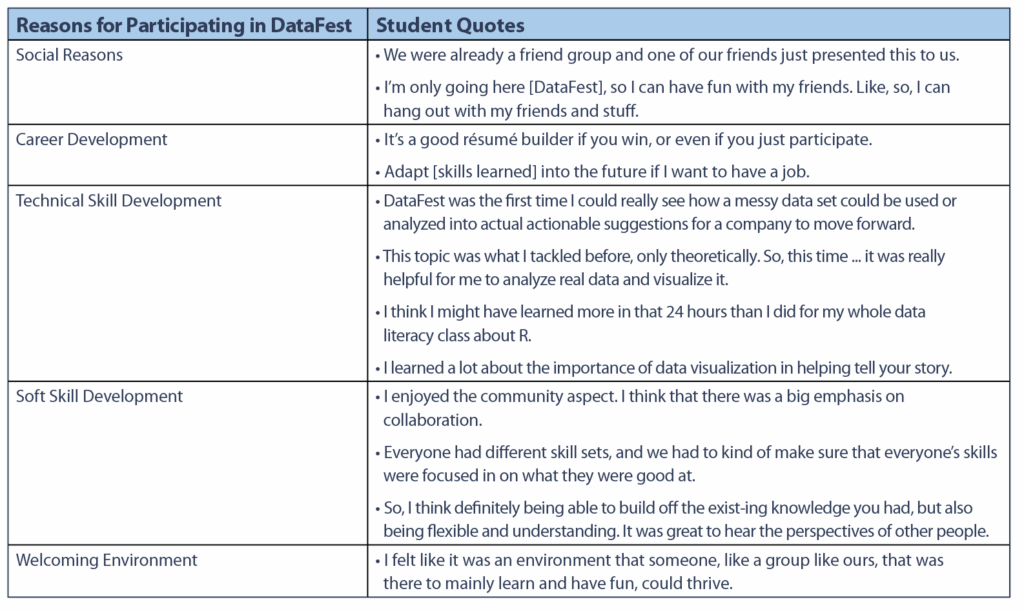
Beyond technical prowess, networking with peers and professionals and career development ranked highly, possibly reflecting students looking toward their future career prospects. The set of quotes in the soft skills development category highlights (see table below) that some participants recognize the importance of soft skill development in terms of teamwork and communication and that these skills will be important in their future careers. While social reasons—such as connecting with friends or meeting new people—were undeniably important, they tended to be secondary drivers when compared to the tangible benefits of skill acquisition and professional development.
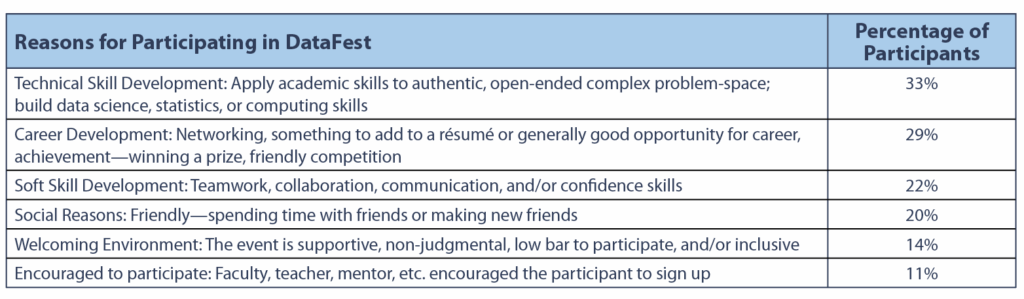
In summary, student participation in DataFest is overwhelmingly driven by a profound desire for practical skill development, particularly in applying statistical and data science methodologies to real-world challenges. Networking opportunities also serve as a strong draw, fostering connections crucial for burgeoning careers. While social engagement and the allure of competition or rewards play supporting roles, they rarely stand as primary motivators. Students’ primary motivations in terms of expanding their technical and soft skill sets might point to the limits of classroom work and how DataFest expands opportunities to develop important skills students do not find in a formal classroom environment.
Factors such as the allure of ‘free stuff’ (e.g., food, swag) or the competitive drive to win were present but generally served as ancillary perks, rather than primary motivators acting more as ‘nice-to-haves’ for students already drawn by the core experience. However, we would recommend site organizers continue to think about swag (because as one participant noted, it adds to the festive atmosphere) and (allergen safe) free food. Free food is important because it builds a sense of community and keeps participants happy and well fed, especially given that some teams travel to DataFest sites.Not having access to free food could create a deterrent for students working on tight budgets. Some participants appreciated the event’s atmosphere, noting the presence of food, advertisements, and other engaging elements that contributed to the overall experience.
The following table uses the same categories as the one above but shares quotes from interview participants to offer additional insights into what motivated these students.
While not often mentioned in surveys or interviews, encouragement from a teacher, mentor, or faculty member appeared as a powerful motivator for some students. One participant described how their data science teacher, who also served as a consultant at DataFest, reassured them they would do fine and there were really no expectations. It seems that for prospective DataFest sites and site organizers, or for groups historically marginalized in STEM, the personal connection faculty can bring by inviting participants and building their confidence may have important implications for broadening participation (see “Who Is DataFest For?” ).
Finally, our data also hinted at site-specific nuances. For example, participants from one site showed a slightly larger proportion of interest in developing teamwork/collaboration skills, while demonstrating a slightly lower emphasis on real-world application skills compared to the overall average. This site also differed from other sites in that it did not have a data science major, only a data science minor. This suggests the local academic offerings or specific promotional strategies for DataFest at a particular institution might subtly shape participant motivations. This raises an intriguing question for organizers: How might we better tailor DataFest experiences or promotional strategies to align with the unique interests and motivations of students at our host site?
Editor’s Note: This material is based on work supported by the National Science Foundation under Grant No. DUE 2216023. Any opinions, findings, and conclusions or recommendations expressed in this material are those of the authors and do not necessarily reflect the views of the NSF.

Jessica Karch
Karch is a senior researcher at TERC, which uses qualitative and mixed methods to study science learning and learning environments at the undergraduate and graduate levels with a focus on equity.

Jennifer Noll
Noll is principal investigator at TERC. Her background focuses on K-12 and undergraduate statistics and data science education through innovative curricula, technology, and teacher professional development.

James K. L. Hammerman
Hammerman co-directs the STEM Education Evaluation Center at TERC. For more than 20 years, he has worked as an evaluator, designer, teacher educator, and adviser for innovative statistics and data science education projects, engaging formal and informal learners of all ages to investigate and make sense of data.

Traci Higgins
Higgins is a senior researcher in STEM education at TERC. She has more than 20 years’ experience conducting research and developing educational materials, processes, and models to support STEM learning and teaching both in and out of school, focusing on K-8 mathematics, data science K-12+, the social sciences, and interdisciplinary thinking.
Leave a Reply