
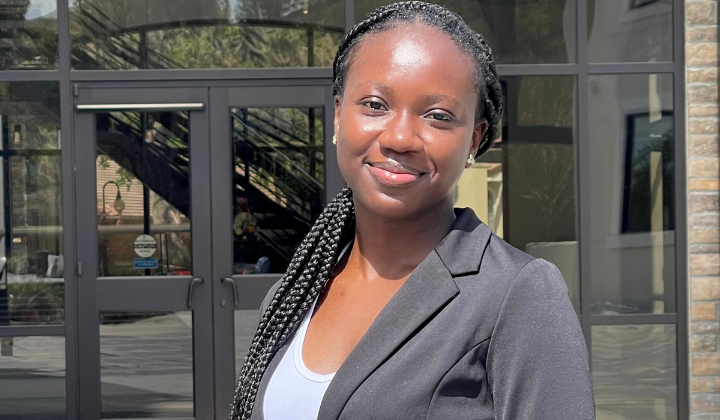
Tell us a little about yourself and your path to pursuing a PhD in biostatistics at UNC.
My name is Akua Kwartemaa Owusu, and I am a PhD student in biostatistics at The University of North Carolina at Chapel Hill. I earned my Bachelor of Science in mathematics with a concentration in biostatistics and data science.
I have always been deeply curious about research. From a young age, I was drawn to understanding the “why” and “how” behind things. I liked asking meaningful questions, examining evidence, and using research to uncover answers that could improve health.
My path became clearer when I discovered biostatistics, a field that allowed me to combine my love of statistics, research, and health. I realized that data could be used to describe health challenges, develop solutions, improve clinical decision-making, and influence policies that affect entire populations. Pursuing a PhD in biostatistics at UNC has allowed me to continue developing the methodological, computational, collaborative, and leadership skills needed to contribute meaningfully to global public health and medical research.
What first sparked your interest in statistics and data science?
My interest began in high school, where I loved my statistics classes and became excited by how numbers and probability could be used to uncover patterns and make predictions.
As I explored the field further, I realized statistics and data science could do much more than simply describe data. They could help improve treatments, inform health policy, and identify inequities affecting individuals and communities. What continues to inspire me is knowing that behind every dataset are real people and real experiences. For me, statistics is about using evidence responsibly to answer meaningful questions and create positive change.
Was there a particular experience or mentor who inspired you to pursue biostatistics?
Yes. My very first mentor, Prince Allotey, played an important role in shaping my journey. I met him through StatFest in 2021, when I was just beginning my studies in biostatistics. He encouraged me, connected me with valuable resources, and introduced me to conferences and professional opportunities that broadened my understanding of the field.
I later attended the Joint Statistical Meetings Diversity Mentoring Program in Toronto, where I met other phenomenal mentors, including Dr. Loni Philip Tabb and Courtney Henry. Their support helped me, and continues to help me, recognize what is possible in biostatistics while reinforcing the importance of mentorship, representation, and professional community.
Along the way, I have been fortunate to meet many other mentors, and I can confidently say that each of them has played a pivotal role in my growth and development.
What research questions or topics are you currently exploring?
My current research spans neurological disease, breast cancer in sub-Saharan Africa, artificial intelligence, and global health.
One area of my work focuses on open questions in Huntington disease, including disease progression, biomarker development, prediction, and clinical trial design. I am also examining how image degradation—including blur, changes in brightness, and reduced contrast—affects the performance and reliability of an AI algorithm designed to detect surgical site infections following cesarean delivery in rural Rwanda.
Together, these projects reflect my broader interest in developing statistical and AI-based tools that are equitable and dependable in real-world settings.
Can you share a project that has been especially meaningful to you?
One of the most meaningful projects I am currently working on examines how image quality affects an AI algorithm designed to identify possible surgical site infections following cesarean delivery in rural Rwanda.
For many mothers in rural or resource-limited communities, returning to a hospital after delivery can be difficult because of distance, transportation costs, and limited access to care. An image-based AI tool could help extend postoperative monitoring and support the earlier identification of complications.
My work evaluates how factors such as blur, poor lighting, and reduced contrast affect the algorithm’s performance. The goal is to identify the minimum image-quality conditions required to maintain accurate predictions. This is especially important because in real-world settings, image quality can vary depending on lighting and how the photograph is captured.
What makes this project so meaningful is that it sits at the intersection of artificial intelligence, global health, and equity. It is ensuring that innovation is safe, practical, and accessible to the mothers and communities who will benefit from it.
What role do you see statistics playing in addressing health disparities?
Statistics helps make health disparities visible, measurable, and actionable. It allows us to identify which communities are being left behind, understand the factors contributing to inequities, and evaluate whether policies and interventions are creating meaningful change.
Our work in Dr. Loni Philip Tabb’s lab examined geographic disparities in cardiovascular health across US counties. This work is a perfect example of how rigorous statistical analysis can uncover disparities that may be hidden within broader averages and provide evidence that guides public health policy and resource allocation.
I am inspired by the advancements happening across statistics and by the people, whose dedication makes them possible. Behind every publication, presentation, and new methodology are years of curiosity, collaboration, perseverance, and hard work.
What advice would you give students considering a career in biostatistics?
Stay curious, and remain open-minded. Biostatistics is a broad and evolving field, with opportunities across public health, pharmaceuticals, clinical trials, genetics, cancer research, artificial intelligence, government, and academia.
I would also encourage students to seek mentorship, attend conferences, become involved in research, build meaningful professional relationships, and embrace opportunities to present and speak, even when those experiences feel intimidating. Challenges are a natural part of the journey, but they can also become powerful steppingstones for growth.
Keep learning. Keep showing up. And never allow difficulty to convince you that you do not belong in this field. Because you do belong, and your unique perspective has tremendous value.
Where do you hope your career takes you after completing your PhD?
I hope to build a career at the intersection of global health and innovative statistical methods that advance public health research across diverse populations.
I also want to advocate for the responsible use of artificial intelligence and emerging technology in biostatistics and healthcare. These tools have tremendous potential, but they must be evaluated for reliability, fairness, transparency, and performance across diverse populations. In healthcare, these tools directly affect a person’s treatment, safety, and life. My goal is to help advance innovation while ensuring it remains ethical.
Why did you become a member of the ASA?
I became an ASA member in 2021. As the only student majoring in biostatistics in my undergraduate program, I wanted to find a professional community where I could connect with like-minded people, learn from others, and deepen my understanding of the field.
Through the ASA, I gained access to mentorship, conferences, scholarships, professional development, and the latest advancements in statistics. The association gave me a strong sense of belonging and showed me the importance of building community, especially for students learning to navigate the field.
You currently serve as an ASA social media ambassador. What drew you to this volunteer opportunity?
I am inspired by the advancements happening across statistics and by the people, whose dedication makes them possible. Behind every publication, presentation, and new methodology are years of curiosity, collaboration, perseverance, and hard work.
As an ASA social media ambassador, I have the opportunity to spotlight meaningful contributions, increase their visibility, and make statistics more accessible to a wider audience. I am especially passionate about supporting students and early-career statisticians by sharing scholarships, conferences, mentorship programs, and other opportunities for growth, while also celebrating their achievements and helping their projects gain the recognition they deserve.
What do you enjoy doing outside of statistics and research?
Outside of my work, I enjoy visiting beautiful cities, kayaking, spending time by the lake, and exploring nature. I also love spending time with my friends and family, whether we are having brunch, sharing new experiences together, or attending church. My faith is an important part of who I am, and these moments help me recharge and stay grounded.
Leave a Reply