
Data and computing shape nearly every aspect of modern life, yet K–12 education has struggled to keep pace. On a recent episode of the Practical Significance podcast, cohosts Donna LaLonde and Ron Wasserstein welcomed Anna Bargagliotti and Nick Horton to discuss the National Academies report Data and Computing in K–12 Education: Foundational Competencies 2026. Read on as they unpack the report’s seven foundational competencies designed to give students the knowledge and skills to navigate an increasingly data-rich and technology-driven world.


Donna LaLonde: Tell us about your day job, or more appropriately, your day jobs.
Nick Horton: I’m a professor of statistics and data science at Amherst College. I work as a biostatistician to help ensure science is on a good foundation, to develop new statistical methods, and to really think about aspects of pedagogy. How do we teach the next generation to take advantage of the data that surrounds them? This really makes me excited.
Anna Bargagliotti: I’m a professor of mathematics, statistics, and data science at Loyola Marymount University in Los Angeles, and like Nick, I wear different hats in my research work. I am a practicing statistician, and I do a lot of work with social statistics, particularly related to education with large datasets. I have a great passion for education: curriculum development, teacher preparation, and guidance in the field of statistics education.
Donna LaLonde: What was the motivation for convening the committee? Also, more importantly, why now?
Nick Horton: It’s no surprise to any of us that over the past few decades, data and computing have permeated nearly all aspects of our lives. Unfortunately, there have been parts of our curriculum that have not moved as quickly as we need.
And the implications for our society and for teaching the next generation were really what spurred folks to say this is the time when we need to look at how we coherently prepare K–12 students to utilize data for making decisions and use computing to process and work with their data.
Ron Wasserstein: What was it like working on a consensus study project, and what surprised you the most about the experience?
Anna Bargagliotti: Working on a consensus study project was different than anything I’ve experienced before, and I’ve had some experience writing national-level reports. But a consensus report is truly just that—participants reaching consensus. There are procedures in place to converge on ideas. There are processes for sharing ideas. There are processes for writing and editing, and everything must be evidence-based.
Essentially, one might have opinions about something, but if there’s not enough evidence to support it, then it cannot be part of the report.
I was quite surprised how much of the process took place in person, which was a huge benefit. We had many in-person meetings, which helped with the “back and forth” on issues because I got a better sense of where people are coming from through in-person dialogue. We had about 20 participants plus other outside experts who met with us.
With so many differing opinions and perspectives, meeting in-person provided convergence much quicker. It was truly delightful to meet people from different disciplines and approach problems from different angles.
Donna LaLonde: Share your insights on how the committee reached the consensus on the foundational competencies.
Nick Horton: It was a remarkable process that was centered on a talented group of committee members from diverse backgrounds and experiences: science educators; computer science educators; engineering; quantum folks; folks from the learning sciences; folks from the more traditional math, statistics, and data science; folks with district experience and state-level industry; and academia and teacher preparation. To have that group think holistically about what was needed was remarkable.
As chair, the consensus process felt a lot like herding cats. We had feisty, smart people bringing all sorts of ideas and helping figure out how to move forward.
What was especially valuable was the amount of work already available. We had standards documents, curriculum guidance, and related resources from several groups, including the ASA’s long-standing efforts. These included the Guidelines for Assessment and Instruction in Statistics Education K–12 report, which complements the GAISE College Report, the Statistics Education of Teachers (SET) report, the Common Core in Mathematics and NCTM Standards, the Next Generation Science Standards, Data Science for Everyone’s K–12 guidance, and the Computer Science Teachers Association’s K–12 computing recommendations.
These are excellent documents, but they are not well integrated. They often use different language to describe similar ideas, and the connections among them are not always clear. So, having the opportunity to bring this group together and develop these seven competencies was remarkable. Here’s an overview of the Foundational Competencies for Data and Computing:
- Competency 1—Problem Posing and Problem-Solving Processes: Students define a problem or question, identify the steps necessary to address it, make an attempt to answer it using tools, reflect on the process, decide on next steps, and iterate.
- Competency 2—Producing and Working with Data: Students can both produce data and assess data quality, organize and prepare data for a variety of purposes, and appraise data by exploring and visualizing it to begin to answer a question or problem.
- Competency 3—Abstraction, Algorithmic Thinking, and Automation: Students deepen their abstraction and logical reasoning skills to design and express solutions to problems in a step-by-step systematic and deterministic way, and they explore concepts and methods of automating data and computing processes.
- Competency 4—Probabilistic and Inferential Reasoning Using Probability for Weather and GPS: Students identify sources of variability and uncertainty, develop probabilistic understanding, carry out statistical investigations and inference using formal testing procedures, and interpret and generalize results as appropriate.
- Competency 5—Models and Representations: Students construct and reason with models and representations to explore phenomena and solve problems. They choose appropriate models for the situation and data available, assess the limitations of models and representations, and recognize the uncertainty inherent in any modeling activity.
- Competency 6—Technology and Society: Students address tensions related to technology and society, values, ethics, and responsibilities.
- Competency 7—Data and Computing Systems: Students develop knowledge of data and computing systems and how they have developed. They are able to make decisions about which computing tools are appropriate for a given task.
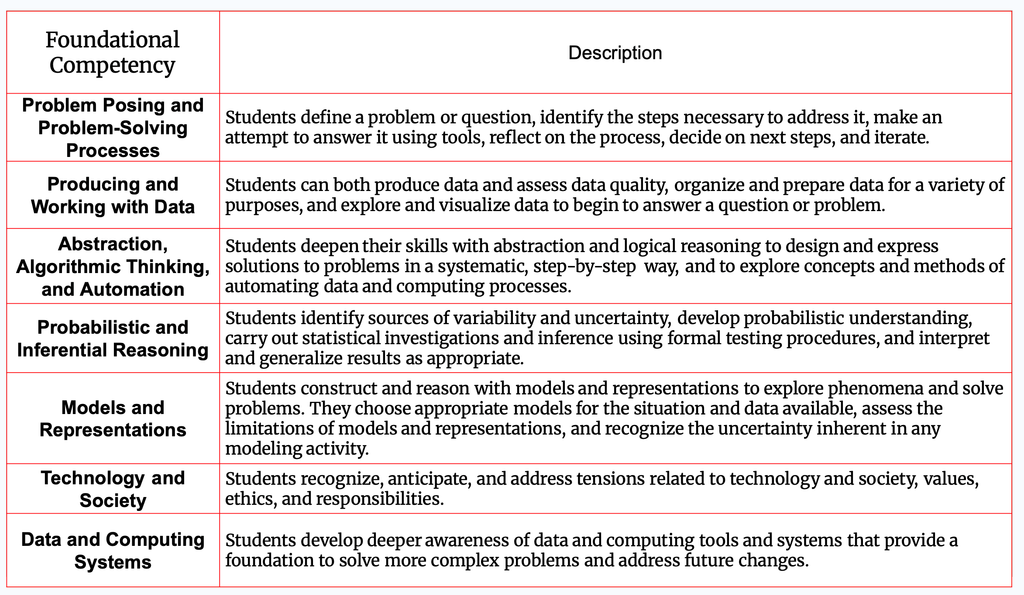
Having this group wrestle with all the standards and work to come up with something more coherent and integrated is something I’m pretty proud of, and I’m looking forward to seeing how it will be implemented.
Ron Wasserstein: The report calls for sustained, coordinated action across curriculum, teacher prep, professional learning, technology access, assessment, and system-level coordination. For a school district or a state curriculum committee that can only focus on one or two of those things, where would you tell them to start?
Anna Bargagliotti: Focusing on teacher prep is the most important in my book to start. Everything else follows from the teacher prep.
Nick Horton: Agreed. Teacher preparation is so important. The teachers haven’t had these experiences with data and computing in the way we want them conveyed to students.
I hope this report will help people better understand the potential of what can happen for all students in K–12. Everything in the report was evidence-based and brought forward through a very rigorous review process.
Ron Wasserstein: Artificial intelligence is explicitly one of the fields the foundational competencies are meant to underpin. How did the committee think about AI literacy?
Nick Horton: We felt it was critical students engage in learning experiences about AI. They need to be thinking about it and learn about the tensions, limitations, and risks of AI. This is a place where the ASA has some guidance. The ASA Statement on Ethical AI Principles for Statistical Practitioners helps us think about these stochastic things, where data quality and ethical considerations show up.
The Models and Representations competency explicitly calls out large language models, as well as weather models, sophisticated scientific predictions, and climate change.
I believe it would have been premature for us to lay out a curriculum for what that should look like. But again, there are key statistical principles about data quality, uncertainty, and variability we need students to be addressing—not just as an add-on in high school, but as something that’s built early on in elementary school.
Anna Bargagliotti: I would reiterate that in a consensus report, you push on what’s evidence-based. Regarding AI, we tried to stick to what is currently known and push for what we agreed should be worked on—more research-based evidence for the use of AI in education and essentially, how, what, when, and where it should be used.
Donna LaLonde: If readers could only read one chapter in the report, what would you point them to and why?
Nick Horton: Chapter 3, because it lays out these competencies. My background is doing applied work in biostatistics, so it gave me a sense of the parts and pieces we really want to be thinking about—competencies that underlie a solid understanding in K–12.
I teach at the university level, so I think about how to build on those things and do that in a more coherent way. Chapter 3 gives people a nice way of seeing how these things fit together—some of which weren’t included in the curriculum I had as a statistician but are important moving forward.
Anna Bargagliotti: I agree—the competency chapter is the crux of the entire report.
Ron Wasserstein: What would success look like in terms of the impact of the report five years on?
Anna Bargagliotti: I would love to see more cohesiveness in the teaching and learning of statistics, data science, and computing throughout K–12, particularly the elementary grades, and moving forward all the way up. Success for this report would be educators and policymakers using the report as a resource to build on when they move forward in their work.
Nick Horton: Mathematical models and statistical models—along with how computer scientists, engineers, and scientists think about models—these are all different. But they talk about the same thing at some level. Providing a more coherent introduction, so students see more holistically the strength, limitations, and weaknesses of models will be helpful.
There are sophisticated methods and models that weren’t taught until graduate school that are now accessible to students early on, which can give them a sense of the power and magic of using the data that surrounds them.
Read the National Academies report, Data and Computing in K–12 Education: Foundational Competencies 2026. You can download the PDF for free.
Leave a Reply