
Mason Chang, Gabriel Lamant, Alexei Khodakovsky, Li Zhang, Alexandra Piryatinska, and Tao He
The seventh K–12 Student Summer Project Program of the San Francisco Bay Area Chapter ran from June through early September, pairing students with volunteer mentors from Bay Area universities and biotech companies to design and complete original data analysis projects.
The program launched on June 9 with a kick-off meeting during which students were matched with mentors and began selecting topics. Throughout the summer, teams met regularly to choose datasets, explore their data, learn statistical methods, and interpret results. Program coordinator Tao He of San Francisco State University encouraged students to build a strong foundation in core concepts rather than reaching immediately for sophisticated methods.
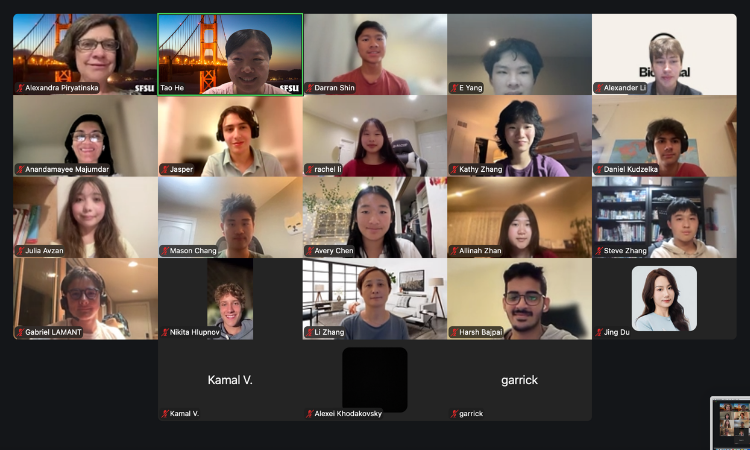
The program culminated on Labor Day, September 7, with a virtual showcase in which students presented their work to chapter members, mentors, family, and friends. This year’s projects spanned forest ecology, financial markets, cancer immunotherapy, dementia, drug policy, and political elections.
Predicting Immunotherapy Response Beyond Tumor Mutational Burden
Returning student Mason Chang (10th, The Harker School), mentored by Xuelian Wei of Vera Therapeutics, investigated whether routine pretreatment clinical factors improve prediction of immunotherapy response beyond tumor mutational burden, called TMB, in metastatic urothelial carcinoma. Using the IMvigor210 cohort, he combined LASSO, or Least Absolute Shrinkage and Selection Operator, stepwise, and stability selection to screen 22 candidate predictors. His first model performed no better than a coin flip. The final model (log-TMB, metastatic site, and Eastern Cooperative Oncology Group performance status) raised cross-validated Area Under the Curve by roughly 0.08 over TMB alone. “Rather than forcing my original hypothesis, I learned to redirect,” he said.
The AI Investment Boom and the Stock Market
Gabriel Lamant (11th) and Alexei Khodakovsky (11th) of Lycée Français de San Francisco and Nikita Hlupnov (11th) of Claremont High School, mentored by Xuefong Hou of Genentech, used the Capital Asset Pricing Model to study how the AI investment surge since 2022 has reshaped the stock market. More than $500 billion in private AI investment preceded major stock gains by roughly 12–18 months. NVIDIA’s beta peaked at 2.7, while diversified companies such as Apple, Microsoft, and Google held steadier betas of 0.7–1.2. Actual returns far exceeded Capital Asset Pricing Model predictions, suggesting the market initially underestimated AI’s effect on earnings. “The project was more interesting because we chose a topic we actually cared about,” the team said.
Predicting Forest Collapse from Space
Allinah Zhan (12th) and Steve Zhang (11th) of Aragon High School, mentored by Alexandra Piryatinska and He, asked whether satellite data can predict forest die-off. Using only 2000–2014 trends in vegetation greenness and canopy water content, they grouped Sierra Nevada pixels into stress tiers. When checked against 2015–2016 bark beetle mortality and wildfire records, which were never used to build the model, damage rose consistently with stress tier. “Real research is messy; there are no pre-defined answers,” the team reflected.
Searching for New Leukemia Biomarkers
Rachel Li (11th, Stanford Online High School) and Kathy Zhang (12th, Crystal Springs Uplands School), mentored by Shagun Gupta of Calico Life Sciences, analyzed a proteomics dataset comparing healthy and acute myeloid leukemia cells alongside Fitbit data from leukemia patients. Differential expression and pathway enrichment analyses pointed to affected mitochondrial and nuclear pathways. In the wearable data, a subgroup with typical heart rates had significantly lower step counts and VO2 max, suggesting wearables could serve as practical proxies for cardiopulmonary exercise tests. Because the datasets did not share patients, “we learned that we have to be careful about the conclusions we draw between datasets,” the students noted.
Modeling Cognitive Decline in Dementia
Jasper Verma (12th, Carlmont High School), mentored by Tuan Nguyen of Alector, applied a mixed model for repeated measures to Mini-Mental State Examination scores in the OASIS dataset. Patients with dementia declined more sharply than those without, and patients with fewer years of education declined significantly more. Verma learned R from scratch to complete the analysis.
What Really Impacts Sleep?
Alexander Li (10th, Internatsgymnasium Schloss Neubeuern), also mentored by Nguyen, worked independently to identify the lifestyle, demographic, behavioral, and biological factors that best predict sleep disorders. Li said the project taught him problem-solving, rigorous data management, and how to communicate research findings.
Revisiting a COVID-19 Treatment Trial
Elvis Yang (10th, CAVA San Mateo) and Darran Shin (10th, Hillsdale High School), mentored by Yinqi Zhao of Kite Pharma, analyzed randomized trial data from RCT Bench on whether ivermectin plus doxycycline improved recovery in patients with grade 1–2 COVID-19. Using logistic regression and receiver operating characteristic analysis, Yang found higher recovery rates within seven days in the treatment arm, while Shin found fewer delayed recoveries beyond 12 days. The pair credited their mentor’s step-by-step structure, from a written proposal to reviewing plots at every meeting.
Did Marijuana Legalization Change Teen Use in California?
Returning student Daniel Kudzelka (11th, Carlmont High School) and Julia Avzan (10th, Sequoia High School), mentored by Anandamayee Majumdar of San Francisco State University, used National Survey on Drug Use and Health survey data and the synthetic control method to build a “synthetic California” from 29 states that did not legalize. Teen use in California fell relative to its synthetic counterpart, but placebo tests yielded a p-value of 0.31, so the team could not attribute the difference to legalization. They said the project sharpened their skills in reformatting inconvenient datasets.
The Age and Gender Gap in the 2024 Election
Returning student Avery Chen (12th, Sacred Heart Preparatory), also mentored by Majumdar, used US Census Bureau data and both parametric and nonparametric tests to compare registration and turnout. Turnout rose steadily with age, except for a sharp drop among women 75 and older, while the gender difference was not statistically significant (p ≈ 0.13). Originally part of a team with members in Japan and Russia, Chen completed the project solo when time zones proved unworkable.
Summary
Across all projects, the most valuable lessons came from the moments when the analysis did not go as planned. Several teams pivoted after early models failed, reported honest null results, or learned to make conclusions drawn from datasets never designed to be combined. For many students, this was their first experience carrying a project from initial question to final presentation, and they left with new fluency in R and Python and greater confidence communicating statistics. Returning students showed how the program builds skills over multiple summers.
Participants expressed deep gratitude to their volunteer mentors, and with the support of the ASA, the program continues to show how local chapters can inspire the next generation of statisticians. Planning for the 2027 program is already underway.
Leave a Reply