
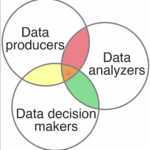
Understanding data allows people to make scientifically sound decisions. This is especially relevant for developing countries. Here Eric Vance and Kim Love show how they help local researchers, businesses and policy-makers from developing countries help make scientifically sound decisions.
Community Analytics Issue
Q&A with Statisticians and Data Scientists Working to Improve Our Communities

These statisticians and data scientists have been working on the front lines to improve our communities, so we asked them to talk about their current projects; who inspired them; and how to get started supporting where we each live, work, learn, and play.
Equity and Bias in Algorithms: A Discussion of the Landscape and Techniques for Practitioners

Algorithmic bias can occur as a result of decisions made throughout the algorithm development and deployment process. Left unaddressed, it can deeply affect equity. Emily Hadley looks at techniques to consider when developing algorithms.
Statisticians and Wildfires at the Wildland/Urban Interface

Although statisticians have been involved in various aspects of wildfire modeling for years, greater numbers of megafires, new data sources, and methodological advancements in statistics and data science are leading to increasing involvement.
A Date with Data: Stepping Toward Data Literacy

Nairanjana (Jan) Dasgupta partners with community organizations, goes to underserved communities, and leads “Date with Data” evenings. She wanted to target elementary children but invited whole families in the hope of having a conversation about data.
Using Data Science in the COVID-19 Pandemic in West Virginia
As one of the team members charged with working with data during the COVID-19 pandemic in West Virginia, Brad Price noticed there was one overall theme: Communicate and share the necessary information to keep the 1.79 million residents, health care facilities, and economy of West Virginia protected. This wasn’t as easy as it might sound.
Supporting Community-Engaged Research Ethical Challenges and Plausible Responses in Statistics, Data Science Practice

Rochelle Tractenberg shows that when practitioners do not follow ethical practice standards, all those who make decisions based on the results of quantitative practice may find their decisions or scholarly work undermined.
Data Literacy as a Tool for Community Health and Social Justice

Data is one of the world’s most valuable resources and an important tool for improving community health. Therefore, knowledge of how to understand, interpret, and share data is necessary for personal and professional success, most importantly for the work of changemaking and improving well-being of low-income and/or predominately minority communities. Understanding these realities, Melody S. Goodman and Janice Johnson Dias have spent the last decade working collaboratively with community members to train and find innovative, time bound, relevant solutions to some of the most intractable health issues facing communities. They have also been training and equipping community members with the language and skills to understand, interpret, design, collect, and share data.
Stephanie Shipp: ‘Democratizing’ Data Science to Serve the Public Good

Shipp is the interim director and a professor at the Social and Decision Analytics Division within the Biocomplexity Institute at the University of Virginia. Working with Sallie Keller, the founding director, she built and developed the division for “democratizing” data science to serve the public good.
Xihong Lin: On the Front Lines of COVID-19 Research

Xihong Lin, biostatistics and statistics professor at Harvard University, and her former post-doctoral fellow, Chaolong Wang, worked day and night to help the world understand COVID-19, what happened in Wuhan, and the steps it took to control the outbreak—including the use of personal protective equipment, which became life-saving.